

Over 65 percent of British small and medium enterprises now rely on cloud hosting for daily operations. The search for efficient, secure platforms is more urgent as businesses face rising digital demands and tighter compliance rules. For IT managers aiming to improve operational efficiency and support digital transformation, this guide dispels common myths and highlights practical distinctions between cloud and traditional hosting options.
Table of Contents
- Cloud Hosting Defined And Common Myths
- Types Of Cloud Hosting And Key Distinctions
- How Cloud Hosting Works For Businesses
- Essential Features For Productivity And Security
- Risks, Costs, And Compliance Requirements
- Comparing Cloud Hosting With Traditional Hosting
Key Takeaways
| Point | Details |
|---|---|
| Understanding Cloud Hosting | Cloud hosting offers scalable digital infrastructure through interconnected servers, unlike traditional hosting. It enables on-demand resource allocation and significant flexibility for businesses. |
| Types of Cloud Hosting | There are various models such as public, private, hybrid, and multi-cloud, each with specific benefits tailored to business needs and security requirements. |
| Productivity and Security Features | Essential features for cloud hosting include dynamic resource allocation and multi-layered security protocols, critical for maintaining operational efficiency and data protection. |
| Risks and Compliance | Businesses must navigate risks related to unpredictable pricing, hidden costs, and strict compliance regulations like GDPR to ensure effective cloud integration and security management. |
Cloud hosting defined and common myths
Cloud hosting represents a sophisticated computing approach where businesses access scalable digital infrastructure through remote, interconnected servers. Unlike traditional single-server hosting, cloud hosting utilises a distributed network of virtualized resources that can dynamically adjust to changing technological demands.
At its core, cloud hosting functions through advanced virtualization technology, pooling computational resources across multiple physical servers. This architecture allows businesses unprecedented flexibility, enabling them to scale computing power, storage, and network capabilities precisely when needed. The critical distinction lies in its ability to provide on-demand services with remarkable elasticity, moving far beyond traditional hosting models that relied on fixed, physical infrastructure.
However, numerous myths persist about cloud hosting that can mislead UK small and medium enterprises. Some believe cloud hosting is simply online file storage or equivalent to basic shared hosting – a misconception that significantly undervalues its transformative potential. According to the National Institute of Standards and Technology, genuine cloud hosting encompasses five essential characteristics:
- On-demand self-service: Businesses can provision computing resources automatically
- Broad network access: Services available across different devices and networks
- Resource pooling: Computing resources dynamically allocated among multiple users
- Rapid elasticity: Infrastructure can quickly scale up or down
- Measured service: Usage can be monitored and reported transparently
Pro tip: Before migrating to cloud hosting, conduct a thorough assessment of your current IT infrastructure to identify precise scalability and performance requirements.
Types of cloud hosting and key distinctions
Cloud hosting offers multiple architectural approaches tailored to diverse business requirements. The primary types include public cloud, private cloud, hybrid cloud, and multi-cloud configurations, each presenting unique infrastructure and operational characteristics for UK enterprises.
Public cloud platforms represent the most accessible model, where computational resources are hosted on third-party infrastructure and shared across multiple organisations. These environments provide remarkable scalability and cost-effectiveness, allowing businesses to access high-performance computing without substantial upfront infrastructure investments. Cloud hosting solutions typically offer pay-as-you-go pricing models, enabling SMEs to optimise their technological expenditure dynamically.
Private cloud architectures, conversely, provide dedicated infrastructure exclusively for a single organisation. These platforms prioritise security and compliance, making them particularly attractive for sectors with stringent data protection requirements such as finance, healthcare, and government. Hybrid cloud strategies combine public and private cloud elements, offering businesses unprecedented flexibility to distribute workloads across different environments based on specific performance, security, and cost considerations.
Multi-cloud approaches have emerged as a sophisticated strategy, allowing organisations to leverage multiple cloud providers simultaneously. This approach mitigates vendor lock-in risks, enhances redundancy, and enables businesses to select optimal services from different providers. Key distinctions between cloud hosting models include:
- Resource allocation: Shared vs dedicated infrastructure
- Security levels: Public accessibility vs isolated environments
- Scalability potential: Instant vs gradual resource provisioning
- Cost structures: Subscription vs capital expenditure models
- Compliance capabilities: Standard vs industry-specific requirements
Pro tip: Conduct a comprehensive workload analysis before selecting your cloud hosting strategy to ensure alignment with your specific operational requirements and technological ecosystem.
Here’s a summary of how each type of cloud hosting benefits UK businesses:
| Hosting Type | Typical Use Cases | Main Advantage | Potential Drawback |
|---|---|---|---|
| Public Cloud | Startups, SMEs | Cost-effective scale | Data privacy concerns |
| Private Cloud | Regulated industries | Enhanced security | Higher upfront investment |
| Hybrid Cloud | Flexible organisations | Customisable balance | Complex management |
| Multi-Cloud | Large enterprises | Avoids vendor lock-in | Integration challenges |
How cloud hosting works for businesses
Cloud hosting transforms traditional IT infrastructure by creating a dynamic, interconnected computing environment that adapts seamlessly to business needs. Resource virtualization enables businesses to allocate computing power dynamically, breaking free from the constraints of traditional single-server hosting models.
At the heart of cloud hosting lies a sophisticated network of physical servers working in concert. These servers are interconnected through advanced virtualisation technology, allowing businesses to draw computational resources from a shared pool. This means organisations can instantly scale their CPU, RAM, and bandwidth requirements without investing in physical hardware. When a business experiences sudden traffic spikes or requires additional processing capacity, cloud infrastructure can automatically redistribute resources to maintain optimal performance.
The technological mechanism behind cloud hosting involves sophisticated load balancing and resource allocation techniques. Multiple physical servers collectively create a virtualised environment where data is continuously replicated across different nodes. Reliable internet connectivity becomes crucial in this architecture, ensuring seamless data transfer and minimal latency. This redundancy provides significant advantages:
- Continuous availability: If one server experiences issues, others immediately take over
- Scalable performance: Resources can be adjusted in real-time
- Cost efficiency: Pay only for resources actually consumed
- Geographic flexibility: Access resources from multiple global locations
- Enhanced security: Data distributed across multiple secure servers
Businesses leveraging cloud hosting benefit from a revolutionary approach to IT infrastructure that prioritises flexibility, resilience, and strategic resource management. By moving away from traditional fixed-capacity models, organisations can create more agile, responsive technological ecosystems.

Pro tip: Conduct a comprehensive network and bandwidth assessment before migrating to cloud hosting to ensure your internet infrastructure can support dynamic resource allocation.
Essential features for productivity and security
Cloud hosting for UK enterprises demands a sophisticated approach that simultaneously addresses productivity and security requirements. Essential cloud computing features enable businesses to balance operational efficiency with robust data protection, creating a resilient technological ecosystem that supports strategic business objectives.
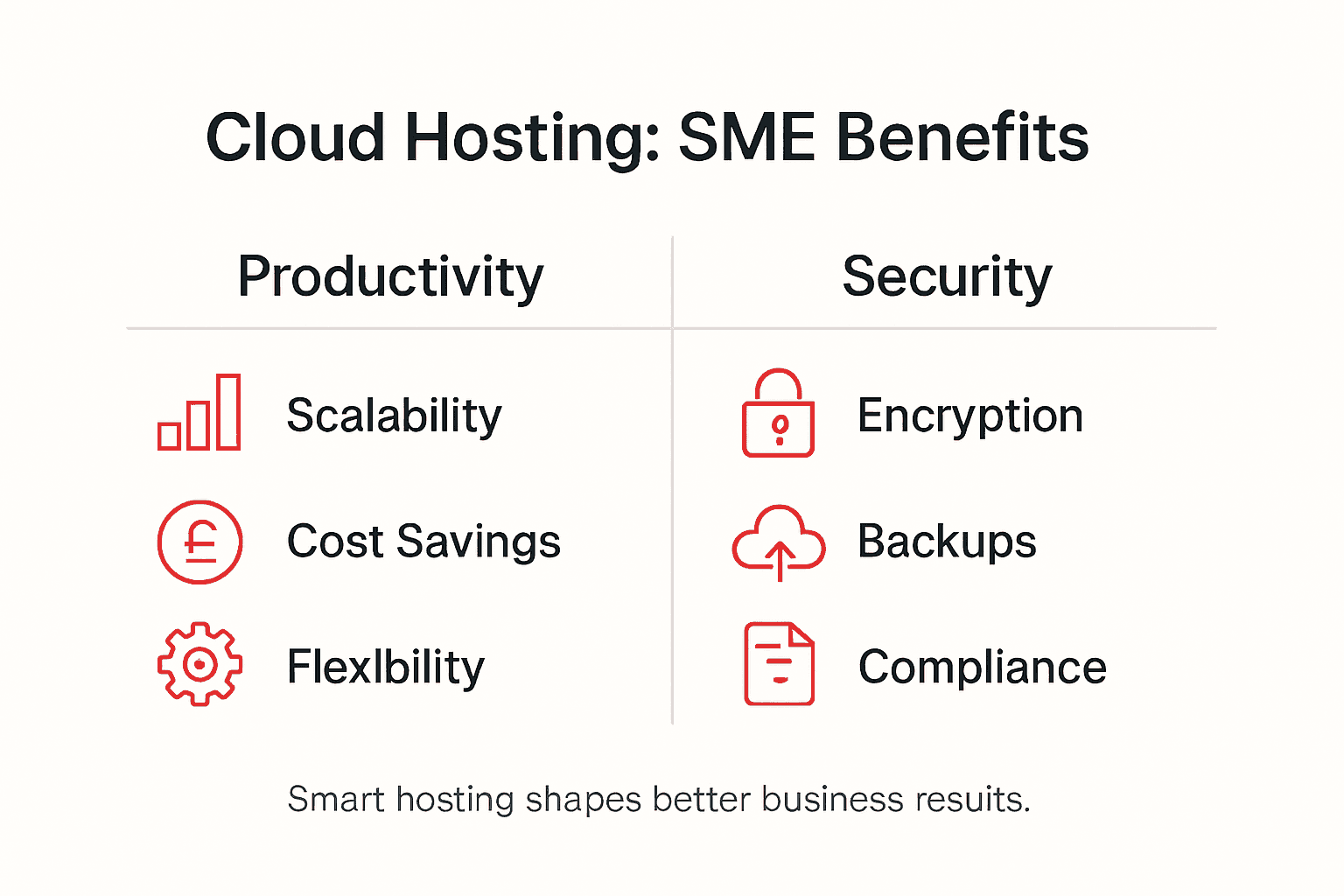
Productivity features in cloud hosting revolve around dynamic resource allocation and seamless accessibility. Businesses can leverage on-demand provisioning, allowing instant scaling of computational resources to match fluctuating workload demands. This means organisations can rapidly deploy applications, adjust computing capacity, and maintain consistent performance without substantial infrastructure investments. The ability to access resources from multiple devices and locations ensures team collaboration remains uninterrupted, regardless of physical workplace constraints.
Security represents the critical counterpart to productivity in cloud hosting environments. Comprehensive network security protocols become essential in protecting sensitive business data from evolving digital threats. Modern cloud platforms incorporate multi-layered security mechanisms that go beyond traditional protective measures:
- Multi-factor authentication: Verifying user identities through multiple validation steps
- End-to-end encryption: Protecting data during transmission and storage
- Continuous threat monitoring: Real-time detection of potential security breaches
- Automated security updates: Ensuring systems remain protected against emerging vulnerabilities
- Compliance adherence: Meeting industry-specific regulatory requirements
Ultimately, successful cloud hosting integration requires a holistic approach that seamlessly combines productivity tools with robust security infrastructure. By selecting platforms that prioritise both operational efficiency and comprehensive protection, UK businesses can create technological environments that drive innovation while maintaining rigorous data safeguards.
Pro tip: Implement regular security audits and employee training programmes to ensure your cloud hosting security measures remain effective and up-to-date.
Risks, costs, and compliance requirements
Cloud hosting presents a complex landscape of potential risks and regulatory challenges for UK small and medium enterprises. Cloud adoption introduces multifaceted vulnerabilities that demand strategic management, requiring businesses to develop comprehensive risk mitigation strategies.
Financial considerations form a critical component of cloud hosting decision-making. While cloud solutions promise cost efficiency, SMEs must navigate unpredictable pricing models, potential hidden expenses, and infrastructure integration costs. Subscription-based pricing can fluctuate based on resource utilisation, making budgetary planning challenging. Organisations must conduct thorough cost-benefit analyses, considering not just immediate expenditure but long-term technological investments and potential efficiency gains.
Compliance represents another significant challenge in cloud hosting environments. UK businesses must adhere to stringent regulatory frameworks such as GDPR, PCI DSS, and industry-specific data protection standards. Vendor and third-party risk management becomes paramount in ensuring comprehensive security and legal compliance. Key compliance considerations include:
- Data sovereignty: Ensuring data storage meets geographical regulatory requirements
- Access controls: Implementing robust authentication and permission management
- Data encryption: Protecting sensitive information during transmission and storage
- Audit trails: Maintaining comprehensive logs of system access and modifications
- Regular security assessments: Conducting periodic vulnerability evaluations
Risk management in cloud hosting extends beyond technological solutions. SMEs must develop holistic approaches that combine technological safeguards with employee training, clear governance policies, and continuous monitoring. Understanding and mitigating potential risks requires ongoing commitment, adaptability, and proactive strategic planning.
Pro tip: Develop a comprehensive cloud risk register that systematically identifies, assesses, and prioritises potential technological and regulatory vulnerabilities.
Comparing cloud hosting with traditional hosting
Cloud hosting represents a paradigm shift from traditional hosting architectures, offering UK businesses unprecedented technological flexibility. Cloud hosting fundamentally transforms infrastructure management through distributed computing technologies, enabling more dynamic and responsive technological ecosystems.
Traditional hosting relies on single, physical servers with predetermined resource limitations. Businesses using traditional models must anticipate peak computational requirements and invest in hardware accordingly, often leading to significant overprovisioning or underutilisation. These fixed infrastructure configurations restrict scalability, requiring substantial upfront capital expenditure and limiting an organisation’s ability to adapt rapidly to changing technological demands.
By contrast, cloud hosting creates a virtualised environment where computational resources are dynamically allocated across interconnected servers. High-quality internet solutions become crucial in enabling this sophisticated infrastructure. The key distinguishing characteristics include:
- Resource allocation: Flexible vs fixed computational capacity
- Scalability: Instant vertical and horizontal scaling
- Cost structure: Pay-per-usage vs capital investment models
- Performance: Distributed load balancing vs single server limitations
- Redundancy: Automatic failover capabilities
Cloud hosting’s architectural advantages extend beyond technical specifications. By decoupling computational resources from physical hardware, businesses can achieve greater operational resilience, reduced technological risk, and more predictable technological expenditure. This approach enables SMEs to compete more effectively in an increasingly digital business landscape.
Pro tip: Conduct a comprehensive workload analysis to determine whether your specific business requirements align more closely with traditional or cloud hosting models.
To help UK SMEs decide between traditional and cloud hosting, consider these core differences:
| Criterion | Traditional Hosting | Cloud Hosting |
|---|---|---|
| Scaling Resources | Manual, slow upgrades | Instant, flexible access |
| Upfront Costs | Significant hardware spend | Subscription-based fees |
| Resilience | Single server risk | Multiple failover nodes |
| Adaptability | Limited infrastructure | Dynamic resource pooling |
Unlock Scalable Cloud Hosting Solutions Tailored for UK SMEs
The article highlights key challenges such as unpredictable IT costs, the need for rapid scalability, and strict compliance demands faced by UK small and medium enterprises when adopting cloud hosting. Understanding terms like on-demand self-service, resource pooling, and rapid elasticity can make navigating this complex landscape easier. At Cloudology.uk, we specialise in delivering secure, flexible cloud hosting services that address these pain points. Our comprehensive expertise ensures seamless migration, enhanced security with multi-layered protections, and cost-effective pay-as-you-go models designed to help your business grow without technological limits.
Ready to transform your IT infrastructure with trusted cloud hosting? Explore how our cloud hosting solutions can provide your business with the agility and resilience it needs today. Learn more on our main site Cloudology.uk and take control of your technology with our expert IT support and network security services. Don’t wait until risks escalate or costs spiral — contact us now to future-proof your business infrastructure.
Frequently Asked Questions
What is cloud hosting, and how does it differ from traditional hosting?
Cloud hosting utilises a distributed network of virtualised resources across multiple servers, allowing dynamic scaling and flexibility. In contrast, traditional hosting relies on a single server with fixed resource limitations, restricting scalability and adaptability.
What are the main benefits of using cloud hosting for UK SMEs?
Cloud hosting offers scalability, cost-effectiveness, enhanced security, and flexibility. SMEs can dynamically adjust their computing resources to meet demand, reduce upfront costs, and improve resilience against failures.
How can cloud hosting improve business performance?
Cloud hosting enhances business performance by providing on-demand self-service resources, ensuring continuous availability, and enabling rapid resource scaling during peak times. This allows businesses to maintain optimal performance without heavy infrastructure investments.
What security measures should UK SMEs consider when using cloud hosting?
UK SMEs should implement multi-factor authentication, end-to-end encryption, continuous threat monitoring, and regular security audits to protect sensitive data and ensure compliance with data protection regulations.