

Nearly half of British small and medium enterprises struggle with managing technology demands while staying within budget. IT outsourcing is reshaping the way organisations approach security and efficiency, reducing costs and giving access to expert support. For IT managers and decision-makers, understanding how this strategy works can be a game-changer for leveraging advanced technology while focusing on core business growth.
Table of Contents
- What Is IT Outsourcing And Why It Matters
- Popular IT Outsourcing Models For SMEs
- How Outsourcing Enhances Business Security
- Cost Savings And Predictable IT Budgeting
- Scaling IT Operations Without The Burden
- Risks And Mistakes To Avoid When Outsourcing
Key Takeaways
| Point | Details |
|---|---|
| Strategic IT Outsourcing | IT outsourcing enables organisations to access specialised expertise while focusing on core business objectives. It allows for cost-effective and scalable technological solutions. |
| Choosing the Right Model | SMEs should assess their needs and organisational maturity to select the appropriate outsourcing model, whether managed services, cloud sourcing, or selective function outsourcing. |
| Enhancing Security Posture | Outsourcing IT security provides SMEs with advanced monitoring and threat detection capabilities, ensuring compliance with regulatory requirements and reducing risk exposure. |
| Cost Management | IT outsourcing transitions unpredictable technology expenses into predictable operational costs, facilitating better financial planning and resource allocation for business growth initiatives. |
What Is IT Outsourcing and Why It Matters
IT outsourcing represents a strategic approach where businesses contract external specialists to manage specific technology functions and infrastructure. At its core, outsourcing allows organisations to leverage specialised expertise without maintaining comprehensive in-house technology teams. The practice involves delegating technology services to third-party providers who can deliver high-quality, cost-effective technological solutions.
For UK small and medium enterprises (SMEs), IT outsourcing offers a transformative opportunity to access enterprise-grade technology capabilities without substantial upfront investments. By partnering with external IT service providers, businesses can tap into specialised skills, advanced technological infrastructure, and robust security frameworks that would be prohibitively expensive to develop internally. The strategic approach allows companies to focus on core business objectives while technology experts manage complex digital ecosystems.
The regulatory landscape further underscores the importance of professional IT outsourcing. The Financial Conduct Authority’s guidance highlights that organisations must carefully manage outsourcing arrangements, ensuring rigorous risk management and contractual oversight. This means businesses are not just purchasing a service, but establishing a comprehensive technological partnership that demands strategic planning, continuous monitoring, and adaptive collaboration.
Pro tip: Before selecting an IT outsourcing partner, conduct a comprehensive assessment of your technological needs, potential provider capabilities, and alignment with your business growth strategy.
Popular IT Outsourcing Models for SMEs
Small and medium enterprises in the United Kingdom have several strategic IT outsourcing models to choose from, each designed to address specific technological and operational requirements. Hybrid sourcing approaches have emerged as a particularly flexible solution, allowing businesses to balance internal capabilities with external expertise.
The most common IT outsourcing models for UK SMEs typically include managed services, cloud sourcing, and selective function outsourcing. Managed services represent a comprehensive approach where external providers handle entire technology infrastructures, including network monitoring, cybersecurity, data backup, and technical support. Cloud sourcing focuses on leveraging external cloud platforms and infrastructure, enabling businesses to access sophisticated technological resources without substantial capital investments. Selective function outsourcing allows companies to contract specific technological tasks or departments, such as software development, helpdesk support, or cybersecurity management.
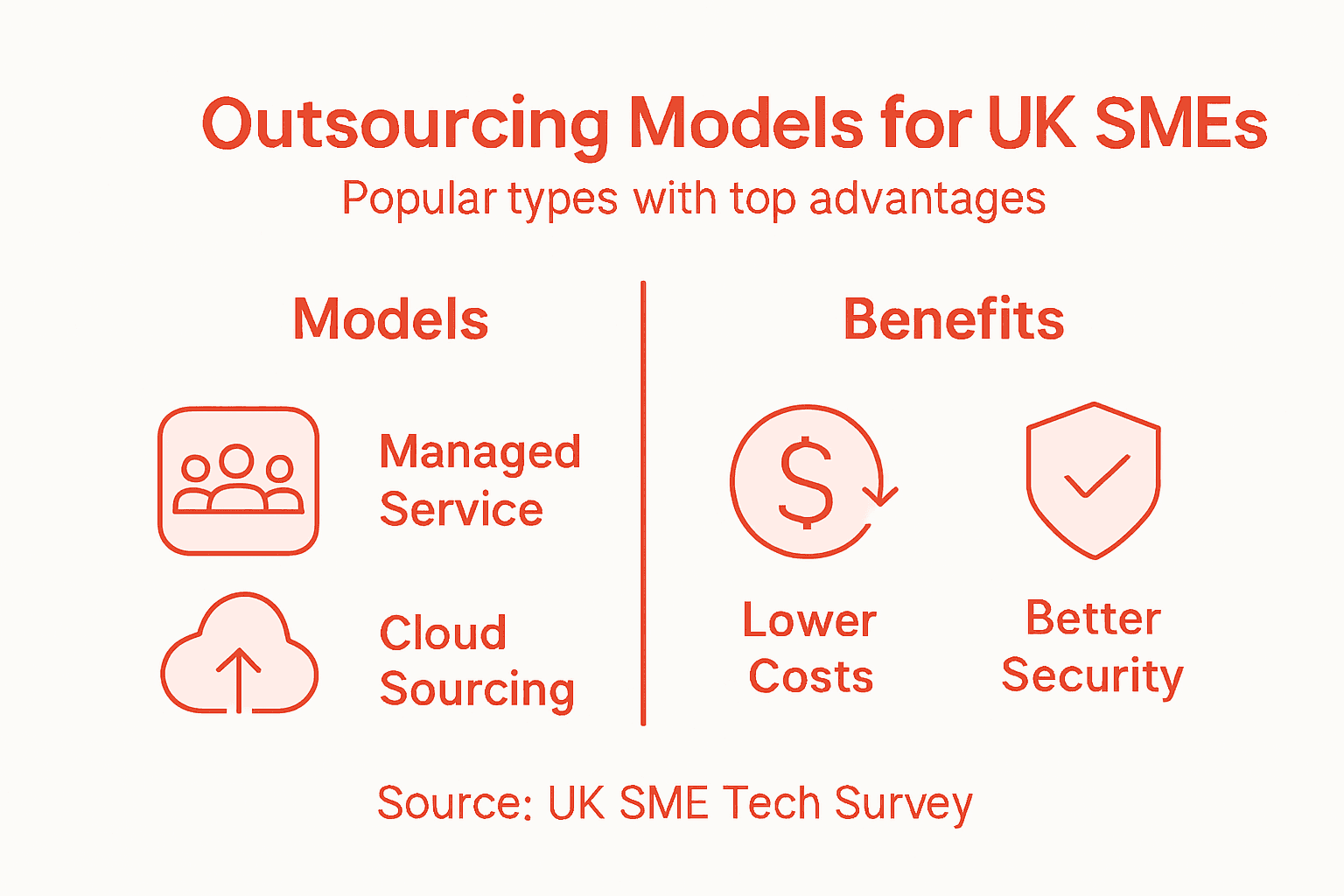
Each outsourcing model offers distinct advantages tailored to different business scales and complexity levels. Small enterprises might prefer selective outsourcing to address specific skill gaps, while medium-sized organisations could benefit from comprehensive managed services that provide end-to-end technological support. The key consideration is aligning the chosen outsourcing strategy with the organisation’s technological maturity, growth objectives, and budgetary constraints.
Here is a comparison of common IT outsourcing models for UK SMEs:
| Model | Best For | Key Advantage | Typical Challenge |
|---|---|---|---|
| Managed Services | Medium enterprises | End-to-end IT coverage | Higher monthly commitment |
| Cloud Sourcing | Fast-growing businesses | Flexible, scalable infrastructure | Data migration complexities |
| Selective Function Outsourcing | Small enterprises | Targeted skill fulfilment | Service fragmentation risks |
Pro tip: Before implementing any IT outsourcing model, conduct a thorough internal audit of your technological infrastructure, skill gaps, and strategic objectives to ensure the most appropriate and cost-effective solution.
How Outsourcing Enhances Business Security
In an increasingly complex digital landscape, UK small and medium enterprises face significant cybersecurity challenges that demand sophisticated protection strategies. Managed security services have emerged as a critical solution, enabling businesses to access advanced technological defences beyond their internal capabilities.
Outsourcing security provides multiple strategic advantages for SMEs. Specialised providers offer round-the-clock monitoring, advanced threat detection, and rapid incident response capabilities that most internal teams cannot sustain. These external experts bring comprehensive knowledge of emerging cyber threats, implementing multi-layered security protocols including intrusion prevention systems, advanced firewall configurations, endpoint protection, and continuous vulnerability assessments. By leveraging external expertise, businesses can effectively mitigate risks associated with data breaches, ransomware attacks, and sophisticated cybercriminal tactics.
Moreover, security outsourcing helps SMEs navigate complex regulatory landscapes, ensuring compliance with stringent data protection requirements. Professional security providers stay updated on evolving legislation, implementing robust frameworks that protect sensitive business and customer information. This approach not only reduces technical vulnerabilities but also minimises potential legal and reputational risks associated with security breaches. Small and medium enterprises can effectively transform their security posture from reactive to proactive, creating a resilient technological environment.
Pro tip: Develop a comprehensive service level agreement (SLA) with your security provider that clearly defines response times, reporting mechanisms, and specific security responsibilities to ensure transparent and effective protection.
Cost Savings and Predictable IT Budgeting
IT outsourcing transforms financial management for UK small and medium enterprises by converting unpredictable technology expenses into structured, manageable operational costs. Roadmapping IT investments enables businesses to create more accurate and transparent budgeting strategies that eliminate surprise expenditures and technological uncertainties.
The financial advantages of outsourcing extend beyond simple cost reduction. Predictable monthly pricing allows SMEs to transform substantial capital expenditures (CapEx) into smaller, consistent operational expenditures (OpEx). This approach provides several key financial benefits: eliminating expensive hardware purchases, reducing maintenance costs, minimising recruitment expenses for specialised IT personnel, and creating a more flexible technological infrastructure. External providers can leverage economies of scale, delivering sophisticated technological capabilities at a fraction of the cost an individual organisation would typically incur.
Additionally, outsourcing mitigates hidden technological expenses that often plague in-house IT management. These include ongoing training costs, software licensing, infrastructure upgrades, cybersecurity investments, and potential downtime expenses. By partnering with professional IT service providers, businesses gain access to cutting-edge technologies and expertise without substantial upfront investments. The predictable pricing model allows for more accurate financial forecasting, enabling leadership to allocate resources more strategically and invest in core business growth initiatives.
Pro tip: Request detailed cost breakdowns and potential scenario analyses from potential IT outsourcing partners to understand the full financial implications and potential savings for your specific business context.
Scaling IT Operations Without the Burden
Scaling technological capabilities represents a significant challenge for UK small and medium enterprises seeking sustainable growth. Outsourcing IT operations provides a strategic solution that enables businesses to expand technological infrastructure without the traditional complexities of internal expansion.
The scalability advantage of IT outsourcing allows organisations to dynamically adjust their technological resources in alignment with business requirements. External providers offer unparalleled flexibility, enabling companies to rapidly onboard new technologies, integrate additional users, or expand across geographical locations without substantial capital investments. This approach eliminates the traditional barriers of recruitment, training, and infrastructure development that typically constrain internal IT teams. Businesses can access specialised skills and enterprise-grade tools on demand, transforming technological scaling from a potential bottleneck into a seamless, strategic opportunity.
Moreover, outsourcing mitigates the inherent risks associated with technological scaling. Professional IT service providers bring comprehensive expertise in managing complex technological transitions, ensuring smooth integration, maintaining security standards, and supporting compliance requirements. They offer robust frameworks for handling fluctuating project demands, reducing the risk of under-resourced initiatives and providing access to cutting-edge technological capabilities that would be prohibitively expensive to develop internally. This approach allows leadership to focus on core business strategies while maintaining technological agility and competitive advantage.
Pro tip: Develop a clear scalability roadmap with your IT outsourcing partner that outlines potential growth scenarios and corresponding technological requirements to ensure seamless, proactive expansion.
Risks and Mistakes to Avoid When Outsourcing
Navigating the complexities of IT outsourcing requires a strategic approach that anticipates potential challenges. Comprehensive risk management becomes essential for UK small and medium enterprises seeking to maximise technological partnerships while minimising operational vulnerabilities.
The most critical risks in IT outsourcing stem from several key areas: vendor selection, communication gaps, and contractual ambiguities. Poor vendor selection can lead to misaligned technological capabilities, cultural incompatibilities, and unexpected performance limitations. Businesses must conduct thorough due diligence, evaluating potential partners’ technical expertise, track record, financial stability, and cultural compatibility. Communication challenges often emerge when expectations are not explicitly defined, leading to misunderstandings about service levels, response times, and technological deliverables. Organisations must establish clear communication protocols, regular reporting mechanisms, and transparent escalation procedures.
Furthermore, SMEs must be vigilant about potential hidden risks such as data security vulnerabilities, compliance challenges, and unexpected cost escalations. Comprehensive service level agreements (SLAs) should explicitly outline performance metrics, security protocols, data handling procedures, and financial terms. This includes detailed provisions for technology transition, ongoing support, potential contract termination, and mechanisms for addressing performance shortfalls. By proactively addressing these potential pitfalls, businesses can transform outsourcing from a potential risk into a strategic technological advantage.
Below summarises major risks in IT outsourcing and strategic mitigations:
| Risk Area | Description | Mitigation Strategy |
|---|---|---|
| Vendor Selection | Poor technical or cultural fit | Rigorous vetting, references |
| Communication Gaps | Misunderstood expectations | Detailed protocols, regular reviews |
| Contractual Ambiguities | Unclear service terms | Explicit SLA, legal consultation |
| Data Security | Potential data breach | Advanced security frameworks |
Pro tip: Create a comprehensive risk assessment matrix before finalising any IT outsourcing agreement, systematically evaluating potential vendor risks across technological, financial, and operational dimensions.
Unlock Smarter, Secure, and Scalable IT Solutions for Your SME
If your UK business is aiming to overcome the challenges of managing complex technology functions while ensuring security and scalability, IT outsourcing offers a clear path forward. This article highlights critical pain points such as risk management, predictable budgeting, and the need for specialised expertise — all areas where many SMEs struggle. At Cloudology.uk, we understand the pressure to balance cost efficiency with robust IT support and cloud infrastructure.
Our comprehensive services, including advanced IT support, secure cloud hosting, and reliable data backup solutions, are designed to simplify your IT management. By partnering with us, you gain access to round-the-clock protection and flexible tech resources without the burden of in-house expansion. Don’t let technology bottlenecks hold your business back.
Ready to transform your IT operations into a strategic advantage? Visit Cloudology.uk today to explore how our tailored outsourcing solutions can help you scale securely and budget smarter. Take the first step towards future-proofing your SME with expert guidance and proven technology partnerships.
Frequently Asked Questions
What are the main benefits of IT outsourcing for SMEs?
IT outsourcing offers several benefits for SMEs, including access to specialised expertise, cost savings, improved security, and scalable technology solutions that allow businesses to focus on their core operations while ensuring that their IT needs are met effectively.
How does IT outsourcing enhance business security?
Outsourcing IT operations allows SMEs to leverage advanced security services, including round-the-clock monitoring, threat detection, and incident response. This ensures better protection against cyber threats and helps maintain compliance with data protection regulations.
What types of IT outsourcing models are available for SMEs?
Common IT outsourcing models for SMEs include managed services, cloud sourcing, and selective function outsourcing. Each model caters to different business needs, allowing companies to choose the approach that best aligns with their technological requirements and budget constraints.
What risks should SMEs consider when outsourcing IT services?
SMEs should be aware of risks such as poor vendor selection, communication gaps, and contractual ambiguities. It is essential to conduct thorough research, establish clear expectations, and create comprehensive service level agreements to mitigate these risks.