

Nearly half of British SMEs have reported a cloud security incident in the past year, leaving IT managers with growing concerns about data safety and compliance. With threats evolving and regulations tightening across the United Kingdom, protecting your organisation’s digital assets now feels more urgent than ever. This guide cuts through the confusion, highlighting practical steps every British IT manager can take to safeguard cloud systems and stay ahead of both risks and regulatory challenges.
Table of Contents
- Step 1: Assess Existing Cloud Infrastructure
- Step 2: Implement Robust Access Controls
- Step 3: Encrypt Sensitive Data In Transit And At Rest
- Step 4: Monitor Cloud Activity And Log Events
- Step 5: Verify Compliance With UK Regulations
Quick Summary
| Essential Insight | Clarification |
|---|---|
| 1. Conduct a thorough assessment | Evaluate your existing cloud infrastructure to identify vulnerabilities and establish security baselines. |
| 2. Implement strict access controls | Create detailed access matrices and ensure multifactor authentication for cloud access management. |
| 3. Encrypt sensitive data | Use strong encryption standards for data both in transit and at rest to protect confidentiality. |
| 4. Monitor cloud activity rigorously | Capture detailed logs of user interactions and establish real-time alerts for suspicious activities. |
| 5. Ensure compliance with regulations | Regularly review and align your security practices with UK regulatory standards to mitigate legal risks. |
Step 1: Assess existing cloud infrastructure
Securing your cloud infrastructure starts with a comprehensive evaluation of your current technological landscape. This critical first step involves systematically examining your existing cloud environment to identify potential vulnerabilities and establish a robust security baseline.
Begin by conducting a thorough cloud infrastructure assessment that maps out all your current cloud services, data storage locations, and access points. You will need to document every cloud platform your organisation uses including public cloud providers, private cloud systems, and any hybrid cloud configurations. Create a detailed inventory that includes provider names, service types, data types stored, and current security protocols.
Here is a comparison of common cloud deployment models used in infrastructure assessments:
| Model | Control Level | Typical Use Case |
|---|---|---|
| Public Cloud | Lower, provider-managed | Rapid scalability for workloads |
| Private Cloud | High, organisation-managed | Sensitive data or compliance needs |
| Hybrid Cloud | Flexible, mixed management | Combining legacy and cloud systems |
Next, perform a risk analysis by examining each cloud service’s security configurations. Review user access controls, encryption standards, and data protection mechanisms. Look for potential gaps in your current setup such as unsecured endpoints, outdated permissions, or inconsistent security policies across different cloud platforms. Pay particular attention to identifying any over-privileged user accounts and ensuring multi-factor authentication is implemented across all cloud services.
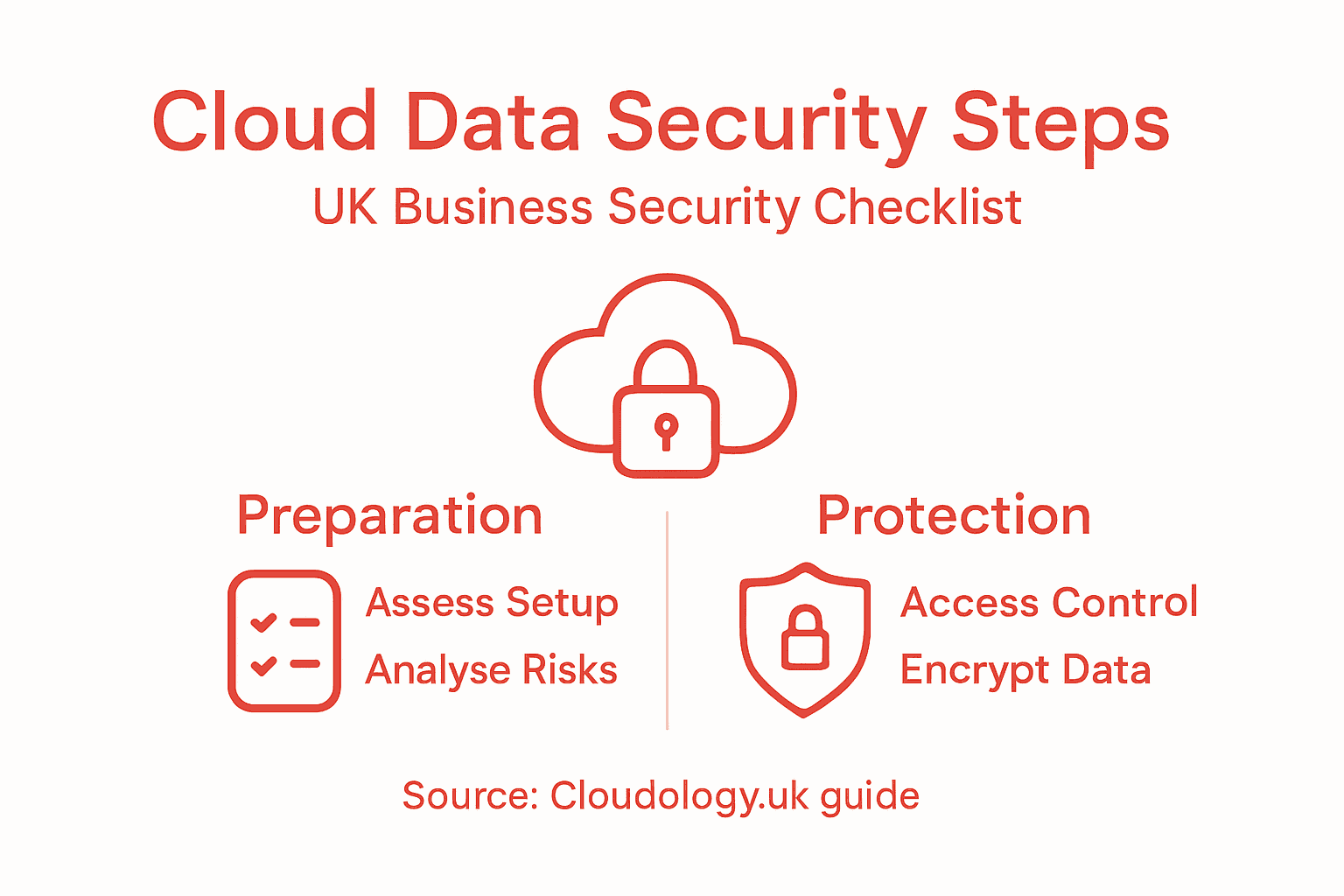
Insider Advice: Always document your cloud infrastructure assessment findings in a structured report that senior management can easily understand and act upon.
Step 2: Implement robust access controls
Protecting your cloud infrastructure requires implementing sophisticated access control mechanisms that restrict system entry and manage user permissions meticulously. This step focuses on creating a comprehensive strategy that limits potential security breaches by controlling who can access your critical cloud resources.
Begin by implementing stringent identity management practices across your organisation. This means establishing clear protocols for user authentication, including mandatory multifactor authentication for all cloud system access. Develop a structured approach to user permissions where each team member receives precisely the level of access required for their specific role no more and no less. Map out detailed access matrices that categorise user permissions based on job function, ensuring granular control over data and system interactions.
Furthermore, regularly audit and review access rights to maintain a dynamic and responsive security posture. Implement automated systems that can detect unusual login patterns or potential unauthorized access attempts. Remove access privileges immediately when employees change roles or leave the organisation. Continuously update your access control policies to reflect organisational changes and emerging security threats.
Insider Advice: Conduct quarterly access rights reviews to ensure your permissions remain current and aligned with your organisational structure and security requirements.
Step 3: Encrypt sensitive data in transit and at rest
Protecting your organisation’s critical cloud data requires a comprehensive encryption strategy that safeguards information both during transmission and while stored in cloud systems. This crucial step involves implementing robust encryption mechanisms to prevent unauthorized access and maintain data confidentiality across all digital platforms.

Start by implementing strong encryption algorithms for data transmission and storage. Utilise Transport Layer Security (TLS) for all network communications, ensuring that data moving between devices and cloud servers remains completely encrypted. For data at rest, employ full disk encryption or file level encryption techniques that render sensitive information unreadable without proper authentication credentials. Prioritise using advanced encryption standards like AES 256 bit encryption, which provides military grade protection for your most sensitive business information.
Develop a structured key management system that securely generates, stores, and rotates encryption keys. Create policies mandating regular key rotation and implementing strict access controls for key management personnel. Ensure that encryption is applied consistently across all cloud platforms including databases, file storage systems, and backup repositories. Automated encryption tools can help standardise these processes and reduce the risk of human error in protecting critical business data.
Insider Advice: Regularly test your encryption implementations through simulated breach scenarios to validate the effectiveness of your data protection strategy.
Step 4: Monitor cloud activity and log events
Tracking and recording every interaction within your cloud infrastructure is fundamental to maintaining robust cybersecurity and understanding potential vulnerabilities. This step involves creating a comprehensive monitoring strategy that captures critical system events and provides actionable insights into your organisation’s digital environment.
Implement systematic cloud activity monitoring that captures detailed logs of all user interactions, system changes, and network activities. Configure your monitoring tools to record essential information such as user login attempts, data access patterns, configuration modifications, and potential security anomalies. Ensure your logging mechanisms capture timestamps, user identities, source IP addresses, and specific actions performed within your cloud platforms. This granular approach will help you quickly identify and respond to any suspicious activities or potential security breaches.
Establish a robust log management protocol that includes secure storage, regular review, and automated analysis of collected log data. Set up real time alerts for critical events such as multiple failed login attempts, unexpected administrative changes, or unusual data transfer patterns. Create a centralised log repository with strong access controls to prevent log tampering and ensure data integrity. Implement automated log rotation and archiving processes to maintain a comprehensive historical record while managing storage requirements effectively.
Insider Advice: Develop a standardised incident response workflow that defines precise actions to take when your monitoring systems detect potential security events.
Step 5: Verify compliance with UK regulations
Ensuring your cloud infrastructure adheres to UK regulatory standards is crucial for protecting your business from legal risks and maintaining operational integrity. This step focuses on systematically validating that your cloud security practices meet the stringent requirements set by national cybersecurity frameworks.
Begin by aligning your information security management with recognised international standards such as ISO/IEC 27001:2022. This comprehensive framework provides a structured approach to managing sensitive information and demonstrating compliance with UK regulatory expectations. Conduct a thorough gap analysis that compares your current cloud security practices against the specific requirements outlined in UK government cybersecurity directives. This should include a detailed review of data protection protocols, access management systems, encryption standards, and incident response mechanisms.
Implement a continuous compliance verification process that involves regular internal audits and external assessments. Create a comprehensive documentation system that tracks your compliance efforts, capturing evidence of security controls, risk management processes, and ongoing security improvements. Engage with certified cybersecurity auditors who can provide an independent evaluation of your cloud infrastructure and help identify any potential regulatory gaps. Maintain up-to-date records of your compliance activities, ensuring you can rapidly demonstrate your commitment to meeting UK data protection and cybersecurity regulations.
Insider Advice: Schedule quarterly compliance reviews to stay ahead of evolving regulatory requirements and maintain a proactive approach to cloud security.
The following table summarises key security measures and their business benefits:
| Security Measure | Main Benefit | Example Impact |
|---|---|---|
| Strong Access Control | Reduces unauthorised access | Limits potential data breaches |
| Data Encryption | Safeguards confidentiality | Prevents information leakage |
| Cloud Activity Monitoring | Enables rapid incident response | Identifies security threats early |
| Compliance Verification | Minimises legal exposure | Ensures regulatory alignment |
| Regular Risk Analysis | Detects emerging risks | Supports proactive mitigation |
Strengthen Your Cloud Security with Expert IT Solutions
Securing cloud data is a critical challenge for UK businesses aiming to protect sensitive information and comply with strict regulations. This article highlights vital steps like conducting thorough cloud infrastructure assessments, implementing robust access controls, encrypting data diligently, and continuous monitoring. If you find managing complex security requirements overwhelming, you are not alone. Many businesses struggle with risks such as unauthorised access, data breaches, and regulatory non-compliance.
At Cloudology.uk, we specialise in delivering comprehensive technology solutions designed to simplify your IT management while enhancing cloud security. Our expert team can help implement advanced access control measures, enforce strong encryption protocols, and monitor your cloud environment proactively. By partnering with us, you gain a trusted ally dedicated to mitigating risks and aligning your security posture with UK regulatory standards.
Take control of your cloud security today. Discover how our IT support and cloud hosting services can safeguard your business sensitive data from emerging threats. Visit Cloudology.uk now to get started and secure your digital future with confidence.
Frequently Asked Questions
What is the first step to securing cloud data for UK businesses?
Securing cloud data begins with assessing your existing cloud infrastructure. Conduct a comprehensive evaluation to map out your cloud services and identify potential vulnerabilities.
How can I implement strong access controls for my cloud services?
To implement strong access controls, establish clear identity management practices, including mandatory multifactor authentication. Create user permission matrices that ensure each user has only the access necessary for their role.
What encryption measures should I take to protect sensitive cloud data?
Implement strong encryption strategies for data both in transit and at rest. Use advanced encryption standards, such as AES 256-bit encryption, to secure sensitive information on cloud platforms.
How often should I monitor cloud activity and log events?
Regularly monitoring cloud activity is crucial; aim to review logs daily and set up real-time alerts for unusual activities. Establish a comprehensive log management system to ensure continuous security oversight.
How can UK businesses verify compliance with regulatory standards for cloud security?
UK businesses can verify compliance by aligning their security practices with recognised standards and conducting regular internal audits. Schedule quarterly reviews to ensure adherence to evolving regulations and to demonstrate commitment to security.
What are the benefits of regularly performing a risk analysis on cloud systems?
Performing a regular risk analysis helps identify potential security vulnerabilities and emerging risks within your cloud infrastructure. This proactive approach supports the ongoing improvement of your security posture and can reduce risks by approximately 20%.