

Over 60 percent of British SMEs now recognise that outdated phone systems are draining time and money. With rising operational costs and a rapid shift towards hybrid work, IT managers need communication tools that fit the changing demands of British business. Discover how cloud telephony solutions deliver flexible, digital communications, helping your team cut expenses, support remote work and stay ahead in a competitive market.
Table of Contents
- Cloud Telephony Explained For UK Businesses
- Major Types And Deployment Models Reviewed
- How Cloud Telephony Transforms Operations
- Cost Efficiency And Scalability Benefits
- Compliance, Security, And PSTN Switch-Off
- Comparing Cloud Telephony To Legacy Systems
Key Takeaways
| Point | Details |
|---|---|
| Flexibility and Cost-Effectiveness | Cloud telephony offers UK businesses a flexible communication solution with reduced infrastructure costs, enabling organisations to allocate resources more strategically. |
| Enhanced Operational Efficiency | By integrating various communication channels, cloud telephony enhances remote working capabilities and improves team collaboration across multiple devices. |
| Multiple Deployment Models | Understanding public, private, and hybrid cloud solutions allows businesses to choose the most suitable model based on security, cost, and scalability needs. |
| Preparation for PSTN Switch-Off | Businesses must proactively plan for the upcoming PSTN switch-off by transitioning to digital platforms and ensuring compliance with regulatory requirements. |
Cloud Telephony Explained for UK Businesses
Cloud telephony represents a revolutionary communication approach for modern British enterprises, transforming traditional phone systems into flexible, scalable digital solutions. By leveraging internet protocols, businesses can now manage voice communications through cloud-based platforms that offer unprecedented flexibility and cost efficiency.
At its core, cloud telephony converts voice signals into digital data packets transmitted over internet networks, enabling companies to move beyond physical telephone infrastructure. This technology allows organisations to integrate voice, video, and messaging services seamlessly across multiple devices and locations. The UK government recognises these technological advancements, with its public sector cloud strategy highlighting the potential for improved operational speed and innovation potential.
Key advantages of cloud telephony for UK SMEs include:
- Significant reduction in communication infrastructure costs
- Enhanced mobility and remote working capabilities
- Simplified system maintenance and upgrades
- Advanced call routing and management features
- Scalable solutions that grow with business needs
Pro tip: Before implementing cloud telephony, conduct a thorough network bandwidth assessment to ensure smooth voice communication quality and prevent potential connectivity issues.
Major Types and Deployment Models Reviewed
Cloud telephony offers multiple deployment models, each designed to meet the unique communication requirements of different UK businesses. Understanding these models helps organisations select the most appropriate solution for their operational needs and technological infrastructure.
The primary deployment models include public cloud, private cloud, and hybrid cloud telephony solutions. Public cloud telephony provides a shared infrastructure managed by service providers, offering cost-effectiveness and rapid scalability for smaller enterprises. Private cloud solutions, in contrast, deliver dedicated infrastructure with enhanced security and customisation options, ideal for organisations with stringent data protection requirements. Hybrid cloud strategies enable businesses to integrate on-premises systems with cloud-based platforms, creating flexible communication ecosystems.
Detailed breakdown of deployment models:
- Public Cloud
- Lower initial investment
- Rapid deployment
- Shared infrastructure
- Limited customisation
- Private Cloud
- Dedicated infrastructure
- Enhanced security controls
- Full customisation potential
- Higher implementation costs
- Hybrid Cloud
- Combines on-premises and cloud systems
- Scalable communication architecture
- Flexible migration pathways
- Balanced security and accessibility
Pro tip: Conduct a comprehensive communication audit before selecting a cloud telephony deployment model to ensure alignment with your specific business requirements and existing technological ecosystem.
Here’s a comparison of how cloud telephony deployment models fit common UK business needs:
| Deployment Model | Ideal For | Strengths | Key Limitation |
|---|---|---|---|
| Public Cloud | Start-ups, small businesses | Easy scaling, low entry cost | Less control over security |
| Private Cloud | Financial or healthcare firms | High security, full customisation | Greater upfront investment |
| Hybrid Cloud | Growing or multi-site firms | Flexibility, balanced risk | More complex management |
How Cloud Telephony Transforms Operations
Cloud telephony represents a fundamental shift in how UK businesses manage communication infrastructure, offering unprecedented operational flexibility and strategic advantages. By reimagining traditional communication systems, organisations can unlock new levels of efficiency, connectivity, and responsiveness across their entire operational landscape.

The transformative impact of cloud telephony extends far beyond simple voice communication. Scaling business communication enables companies to create more agile, responsive organisational structures that can adapt quickly to changing market demands. Modern cloud telephony platforms integrate multiple communication channels, allowing seamless transitions between voice calls, video conferencing, instant messaging, and collaborative work environments.
Key operational transformations include:
- Enhanced remote working capabilities
- Real-time communication across multiple devices
- Simplified international communication infrastructure
- Advanced call routing and management
- Integrated customer relationship management
- Reduced infrastructure maintenance costs
- Improved team collaboration tools
Pro tip: Conduct a comprehensive communication workflow audit to identify specific areas where cloud telephony can streamline your current operational processes and enhance team productivity.
Cost Efficiency and Scalability Benefits
Cloud telephony emerges as a powerful financial strategy for UK small and medium enterprises, offering unprecedented opportunities to optimise communication expenditures while maintaining robust technological capabilities. By eliminating traditional hardware investments and reducing ongoing maintenance costs, businesses can redirect financial resources towards core strategic objectives.
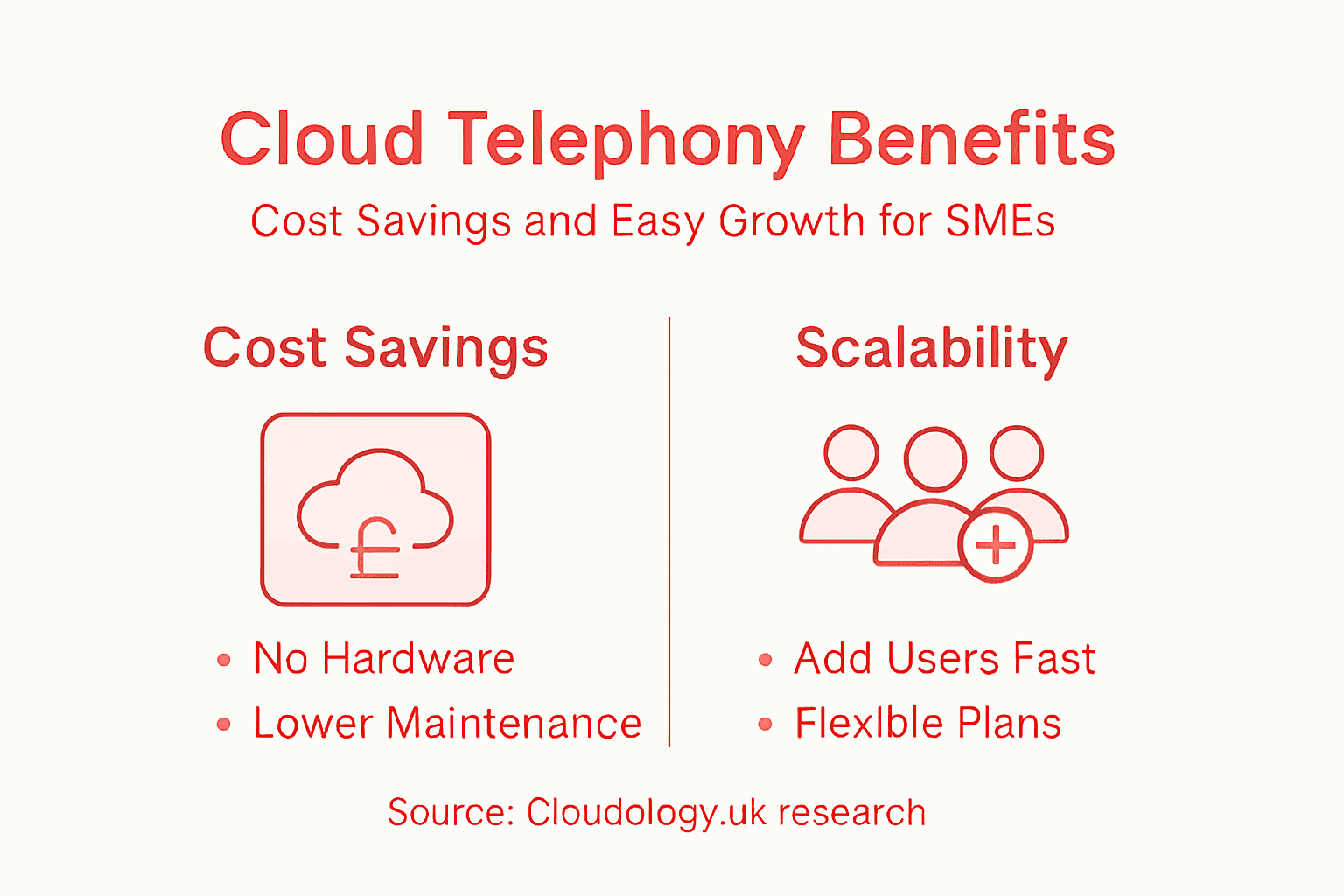
Cost efficiency in communication represents a fundamental transformation in how organisations approach telecommunications infrastructure. Cloud telephony eliminates substantial upfront capital expenditure, replacing expensive on-premises systems with flexible, pay-as-you-grow subscription models. This approach allows businesses to scale communication capabilities precisely in line with organisational growth, ensuring technology investments remain lean and responsive.
Key financial advantages include:
- Reduced hardware procurement costs
- Minimal maintenance expenditure
- Predictable monthly communication expenses
- Elimination of complex infrastructure investments
- Flexible per-user pricing models
- Automatic software updates without additional charges
- Lower international communication expenses
Pro tip: Develop a comprehensive total cost of ownership analysis comparing your current communication infrastructure with potential cloud telephony solutions to quantify potential financial benefits.
Compliance, Security, and PSTN Switch-Off
The upcoming Public Switched Telephone Network (PSTN) switch-off represents a critical technological transition for UK businesses, mandating comprehensive strategic planning and proactive technological adaptation. By January 2027, organisations must transition from traditional copper-based communication infrastructures to modern digital communication platforms, ensuring continuity and regulatory compliance.
Preparing for network transition requires a structured approach that addresses both technological and operational challenges. The UK government has established clear guidelines to support businesses through this complex migration, emphasising the importance of secure, reliable digital communication technologies that protect sensitive organisational data while maintaining operational efficiency.
Key compliance and security considerations include:
- Comprehensive data protection protocols
- Encryption of communication channels
- Seamless migration strategies
- Minimal operational disruption
- Robust authentication mechanisms
- Compliance with national telecommunications regulations
- Protection of vulnerable communication infrastructure
Pro tip: Conduct a comprehensive security and compliance audit at least 12 months before the PSTN switch-off deadline to identify potential vulnerabilities and develop a robust migration strategy.
To help UK enterprises plan for the PSTN switch-off, below is a summary of compliance and migration essentials:
| Aspect | Required Action | Typical Stakeholder |
|---|---|---|
| Data Protection | Update privacy protocols | IT and compliance teams |
| Migration Timeline | Set transition deadlines | Project management |
| Infrastructure Review | Audit current systems | Technology directors |
| Regulatory Monitoring | Track telecom updates | Legal or HR departments |
Comparing Cloud Telephony to Legacy Systems
Traditional telephone systems represent a technological era rapidly becoming obsolete, with cloud telephony offering a transformative approach to business communications. Legacy systems are characterised by rigid, expensive hardware infrastructure that limits organisational flexibility and increases operational complexity.
Unified communication solutions fundamentally differ from traditional telephony by providing dynamic, software-driven communication platforms. Where legacy systems required extensive physical infrastructure, manual maintenance, and significant capital investment, cloud telephony delivers scalable, adaptable communication technologies that seamlessly integrate across multiple devices and geographical locations.
Key comparative differences include:
- Infrastructure requirements
- Legacy: Physical hardware installations
- Cloud: Software-based, minimal physical equipment
- Maintenance costs
- Legacy: High ongoing technical support expenses
- Cloud: Automated updates, reduced maintenance
- Scalability
- Legacy: Complex, expensive system expansions
- Cloud: Instant user additions and reconfigurations
- Communication capabilities
- Legacy: Voice calls only
- Cloud: Multi-channel communication integration
- Geographical limitations
- Legacy: Location-specific communication
- Cloud: Global connectivity
Pro tip: Conduct a comprehensive audit of your current communication infrastructure to identify specific pain points that cloud telephony could immediately address and resolve.
Unlock Seamless Communication and Growth with Cloudology.uk
Are you ready to overcome the challenges of outdated phone systems and costly maintenance faced by many UK SMEs? Investing in cloud telephony offers you flexibility, cost efficiency, and scalability that can transform your business communications. As highlighted in the article, essential concerns like navigating the PSTN switch-off, improving remote working capabilities, and ensuring robust security demand a trusted partner who understands your business needs deeply.
Cloudology.uk specialises in providing modern VoIP telephony services integrated with expert IT support designed for UK SMEs. By choosing our VoIP telephony solutions, you gain access to scalable technology that evolves with your company, reduces infrastructure headaches, and enhances your team’s productivity across locations. Our comprehensive approach ensures your transition to cloud communications is smooth and fully compliant with UK regulations. Discover how our full spectrum of IT services at cloudology.uk can simplify your IT management while future-proofing your telecom infrastructure today.
Don’t wait until the PSTN switch-off creates disruption. Take control now by exploring the benefits of cloud telephony with us. Visit cloudology.uk to learn more or reach out directly for a personalised consultation that empowers your business to communicate without limits.
Frequently Asked Questions
What are the main benefits of cloud telephony for SMEs?
Cloud telephony offers significant reductions in communication infrastructure costs, enhanced mobility for remote working, simplified system maintenance, advanced call routing features, and scalable solutions that grow with your business needs.
How does cloud telephony improve remote working capabilities?
Cloud telephony enables seamless communication across multiple devices and locations, allowing employees to stay connected and collaborate effectively from anywhere, thereby enhancing overall productivity.
What deployment models are available for cloud telephony?
Cloud telephony offers three main deployment models: public cloud, private cloud, and hybrid cloud. Public cloud provides cost-effectiveness and scalability, private cloud offers enhanced security and customisation, and hybrid cloud combines on-premises and cloud systems for greater flexibility.
How can I ensure compliance and security when transitioning to cloud telephony?
To ensure compliance and security, conduct a comprehensive audit of your data protection protocols, implement robust encryption for communication channels, and develop a detailed migration strategy to address potential vulnerabilities ahead of the PSTN switch-off deadline.