

Phishing scams are threatening the security of nearly every British business today. Attackers now use highly targeted tactics, blending fake messages with detailed knowledge of company operations. With criminals sending billions of deceptive emails worldwide each year, protecting sensitive information requires more than basic IT tools. This article reveals the latest phishing threats facing British organisations, clarifies common misconceptions, and highlights practical steps IT managers can use to strengthen their defences.
Table of Contents
- Phishing Defined: Modern Threats And Misconceptions
- Types Of Phishing Attacks Facing UK SMEs
- How Phishing Works: Anatomy Of An Attack
- Legal Compliance And UK Regulatory Duties
- Consequences For Businesses And How To Respond
- Building A Strong Defence: Best Practices For SMEs
Key Takeaways
| Point | Details |
|---|---|
| Understanding Phishing | Phishing is a sophisticated cybercrime involving deception to extract sensitive information from individuals or organisations. Modern techniques often bypass traditional security measures, requiring heightened awareness. |
| Types of Attacks | SMEs face various phishing threats, including Email Phishing, Smishing, Vishing, Spear Phishing, and Whaling, each targeting different vulnerabilities within organisations. |
| Organisational Responsibility | Phishing represents a comprehensive risk that requires organisational strategies, including staff training and robust incident response protocols, rather than being seen as solely an IT issue. |
| Regulatory Compliance | UK businesses must adhere to stringent cyber security regulations, which impose significant legal obligations for data protection and risk management to prevent potential breaches and penalties. |
Phishing Defined: Modern Threats and Misconceptions
Phishing represents a sophisticated form of cybercrime that targets businesses through calculated psychological manipulation. Criminals leverage digital communication channels to impersonate trusted entities, attempting to extract sensitive financial and personal information through carefully constructed messages. The term originates from the fishing analogy, where fraudulent messages act as bait designed to lure unsuspecting victims into sharing confidential data.
Modern phishing attacks have evolved far beyond simple email scams, becoming increasingly complex and challenging to detect. Contemporary phishing strategies continue to grow in sophistication, with criminal networks developing targeted approaches like spear phishing and whaling attacks that exploit organisational trust networks. These advanced techniques often involve detailed research about specific individuals or companies, creating messages so personalised they can bypass traditional security mechanisms.
The scale of phishing threats is substantial. In a striking example from May 2023, the University of Oxford’s email gateway blocked over 62 million phishing emails attempting to infiltrate institutional networks, underscoring the pervasive nature of these digital attacks. Typical phishing attempts rely on emotional manipulation, creating scenarios of artificial urgency that pressure recipients into making hasty decisions without proper verification.
Businesses must recognise that phishing is not merely an IT problem but a comprehensive organisational risk requiring multi-layered defence strategies. Effective protection demands a combination of technological solutions, rigorous staff training, and robust incident response protocols.
Pro tip: Implement regular simulated phishing training exercises to help employees recognise and respond appropriately to potential cyber threats.
Types of Phishing Attacks Facing UK SMEs
Phishing attacks have become an increasingly sophisticated threat to small and medium-sized enterprises (SMEs) across the United Kingdom. Recent research indicates that 79% of businesses have experienced phishing attempts, highlighting the critical need for comprehensive cybersecurity awareness and defence strategies.
The landscape of phishing threats is diverse, encompassing multiple attack vectors that target different organisational vulnerabilities. Spear phishing and whaling represent particularly dangerous strategies that exploit detailed knowledge about specific individuals or organisations, often involving meticulously researched personalised messages designed to manipulate recipients. These attacks go beyond generic mass phishing campaigns, instead focusing on precision targeting of key personnel with access to financial systems or sensitive corporate information.
UK SMEs face several primary phishing attack types, including:
- Email Phishing: Traditional method using fraudulent emails mimicking trusted sources
- Smishing: Text message-based attacks attempting to extract sensitive information
- Vishing: Voice call scams impersonating legitimate business or government representatives
- Spear Phishing: Highly personalised attacks targeting specific individuals using detailed personal information
- Whaling: Sophisticated attacks focused on senior executives and high-profile business leaders
These attacks frequently leverage recognisable brand identities, such as Microsoft or other trusted corporate entities, to create a veneer of legitimacy that increases the likelihood of successful deception.
To clarify the unique risks of each attack type, see this comparative table:
| Attack Type | Typical Target | Attack Methodology | Distinctive Risk |
|---|---|---|---|
| Email Phishing | All staff | Fake emails, generic content | Broad reach, easy to mass send |
| Smishing | Mobile device users | Deceptive SMS messages | Bypasses email defences |
| Vishing | Phone line holders | Voice call impersonation | Human error over the phone |
| Spear Phishing | Specific individuals | Carefully researched emails | Tailored to bypass suspicion |
| Whaling | Senior executives | Rank-targeted, high-stakes emails | Significant financial exposure |
Pro tip: Develop a comprehensive staff training programme that includes regular simulated phishing exercises to help employees recognise and respond to evolving cyber threats.
How Phishing Works: Anatomy of an Attack
Phishing attacks represent a calculated form of social engineering designed to exploit human psychology and organisational vulnerabilities. These sophisticated cyber attacks are meticulously constructed to bypass traditional security mechanisms by manipulating emotional triggers and creating scenarios that prompt immediate action.

The typical phishing attack follows a carefully orchestrated three-stage process. First, attackers create a fraudulent digital infrastructure including fake websites and communication channels engineered to capture sensitive information. These platforms are designed to closely mimic legitimate business interfaces, making them challenging to distinguish from authentic sources. The second stage involves crafting compelling messages that trigger emotional responses like urgency, fear, or curiosity, compelling recipients to act without thorough verification.
Modern phishing attacks demonstrate remarkable complexity in their approach. Criminals utilise various distribution strategies, ranging from high-volume mass campaigns with low conversion rates to precisely targeted attacks leveraging detailed corporate intelligence. The primary objectives remain consistent: capturing login credentials, installing malware, initiating financial transfers, or breaching organisational security protocols.
Key psychological manipulation techniques employed in phishing attacks include:
- Creating artificial time pressure
- Mimicking authoritative communication styles
- Exploiting current events or organisational contexts
- Leveraging recognisable brand identities
- Triggering emotional responses like anxiety or excitement
Pro tip: Implement mandatory multi-factor authentication and regular cybersecurity awareness training to significantly reduce your organisation’s vulnerability to sophisticated phishing attempts.
Legal Compliance and UK Regulatory Duties
Recent legislative developments in the United Kingdom have significantly transformed the legal landscape for cybersecurity compliance, particularly concerning phishing prevention and organisational responsibilities. The Cyber Security and Resilience Bill introduced in 2025 represents a pivotal moment for UK businesses, establishing more stringent requirements for digital protection and risk management.
Organisations must now navigate complex legal obligations under the UK GDPR and Data Protection Act 2018, which mandate comprehensive technical and organisational measures to prevent and mitigate cyber threats. These regulatory frameworks impose strict requirements for data protection, emphasising proactive risk management and robust incident response protocols. Businesses failing to implement appropriate safeguards face potential consequences including:
- Substantial financial penalties
- Regulatory enforcement actions
- Contractual breach implications
- Significant reputational damage
- Potential legal liability for security failures
The evolving regulatory environment demands a holistic approach to cybersecurity, requiring businesses to demonstrate not just technical capability, but a strategic commitment to protecting digital assets and customer information. This means developing comprehensive risk assessment processes, implementing advanced security technologies, and creating transparent incident response mechanisms that align with legal expectations.
Key compliance requirements now extend beyond traditional IT security measures, encompassing broader organisational accountability and proactive risk management strategies. Businesses must maintain detailed documentation of their cybersecurity practices, regularly update their protective mechanisms, and ensure continuous staff training on emerging cyber threats.
Pro tip: Conduct an annual comprehensive cybersecurity audit that maps your current practices against the latest regulatory requirements to ensure ongoing legal compliance and minimise potential vulnerabilities.
Consequences for Businesses and How to Respond
Phishing attacks represent a significant financial and operational threat to UK businesses, with potential consequences extending far beyond immediate monetary losses. The impact of a successful cyber attack can be devastating, potentially compromising an organisation’s entire operational integrity and long-term sustainability.
The financial ramifications of a phishing breach can be extensive and multifaceted, encompassing direct monetary losses, operational disruption, and significant regulatory penalties. Businesses may experience:
- Direct financial theft
- Operational downtime
- Increased insurance premiums
- Costs of data recovery and system restoration
- Potential regulatory fines up to 4% of global turnover
- Substantial reputational damage
Navigating the aftermath of a phishing attack requires a strategic, comprehensive response. Organisations must immediately halt compromised communication channels, report the incident to relevant authorities like Action Fraud, conduct thorough forensic investigations, and implement robust remediation strategies. This process involves identifying the breach’s extent, securing vulnerable systems, and developing enhanced protective measures to prevent future incidents.
The long-term consequences extend beyond immediate financial impact. A single phishing incident can erode customer trust, damage brand reputation, and potentially lead to permanent loss of business relationships. Proactive cybersecurity measures, continuous staff training, and maintaining a robust incident response plan are crucial for mitigating these risks.
A quick overview of business consequences and recommended response steps:
| Consequence | Immediate Impact | Recommended Response |
|---|---|---|
| Financial loss | Direct theft or fraudulent payments | Isolate & secure accounts |
| Operational disruption | System downtime, lost productivity | Restore systems from backup |
| Reputational damage | Loss of client trust or goodwill | Transparent client updates |
| Regulatory action | Fines or legal sanctions | Report to regulators quickly |
| Increased costs | Insurance premiums or recovery spend | Review and strengthen controls |
Pro tip: Develop a comprehensive cyber incident response plan that includes clear protocols for immediate action, communication strategies, and systematic recovery procedures to minimise potential damage from phishing attacks.
Building a Strong Defence: Best Practices for SMEs
Defending against phishing attacks demands a comprehensive, multi-layered approach that integrates technological solutions with human awareness, tailored specifically to the unique vulnerabilities of small and medium-sized enterprises.
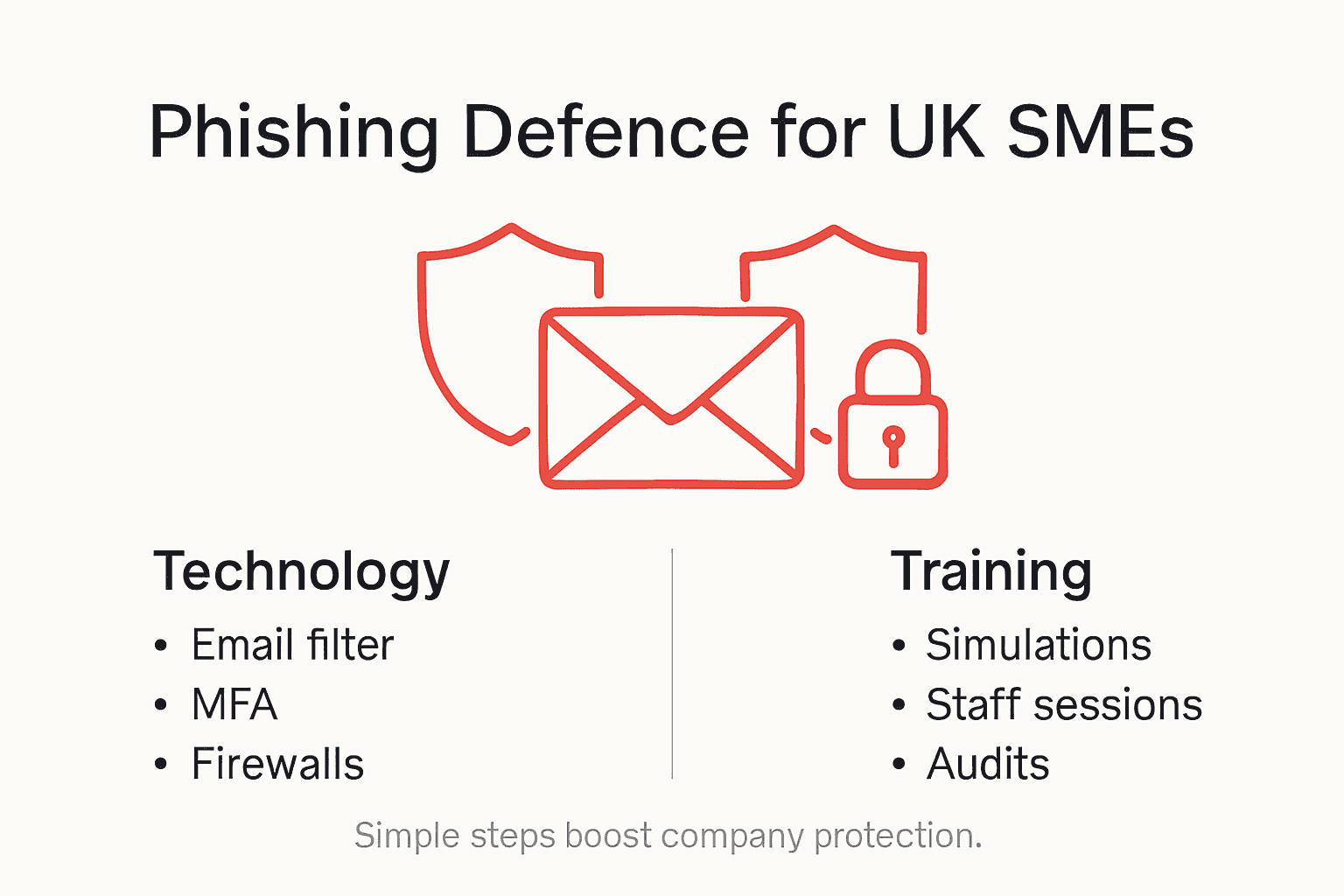
UK SMEs must adopt practical, proactive cybersecurity measures that address both technical infrastructure and organisational culture. These strategies should encompass multiple defensive dimensions:
Technical Infrastructure Protection:
- Implement robust email filtering systems
- Install advanced firewall technologies
- Utilise comprehensive antivirus software
- Maintain regular software and security patch updates
- Deploy multi-factor authentication protocols
Human Awareness and Training:
- Conduct regular cybersecurity awareness training
- Develop clear, comprehensive security policies
- Create simulated phishing exercise programmes
- Establish transparent reporting mechanisms for suspicious activities
- Promote a culture of continuous learning and vigilance
The evolving landscape of cyber threats, particularly AI-enabled scams and sophisticated impersonation tactics, requires SMEs to remain adaptable and consistently informed. Organisations must view cybersecurity not as a static solution but as a dynamic, ongoing process of assessment, learning, and improvement.
Pro tip: Implement quarterly cybersecurity audits and training refreshers to ensure your team remains current with the latest phishing prevention strategies and emerging threat landscapes.
Strengthen Your Business Defence Against Phishing Threats Today
Phishing attacks continue to evolve, targeting UK SMEs with sophisticated techniques like spear phishing and whaling that exploit organisational trust and human psychology. If your business feels vulnerable to these deceptive scams, it is crucial to act immediately. Protect your digital infrastructure with comprehensive solutions that blend advanced technology and employee awareness to reduce risk and maintain compliance with UK regulations.
At Cloudology.uk, we specialise in delivering tailored IT services including secure cloud hosting, resilient data backup solutions, and robust network protection designed specifically for SMEs. We help you stay ahead of emerging cyber threats by simplifying IT management and implementing multi-layered defences that align with your unique business needs. Take the first step in safeguarding your operations by exploring how our IT support services can enhance your resilience. Visit Cloudology.uk now to secure your IT environment and ensure your business does not fall victim to phishing attacks.
Frequently Asked Questions
What are the common types of phishing attacks?
Phishing attacks include email phishing, smishing (SMS phishing), vishing (voice phishing), spear phishing, and whaling. Each type targets different individuals or methods, with some being more personalised than others.
How can businesses protect themselves from phishing attacks?
Businesses can protect themselves by implementing robust email filtering, using multi-factor authentication, conducting regular cybersecurity training, and creating simulated phishing exercises to improve staff awareness and response.
What should businesses do immediately after a phishing attack?
Immediately after a phishing attack, businesses should secure compromised accounts, report the incident to relevant authorities, conduct a forensic investigation, and improve their security measures to prevent future incidents.
Why is phishing considered a significant threat to businesses?
Phishing is a significant threat because it often leads to financial theft, operational disruption, and reputational damage. Successful attacks can result in substantial regulatory penalties and loss of customer trust, impacting long-term business sustainability.
Recommended
- The Benefits of Testing Staff’s Resilience to Cyber Attacks Using Phishing Simulations – Cloudology
- Cybersecurity Education and Training for Employees – Cloudology
- Preventing Reputational Damage Through Robust IT Security Practices – Cloudology
- Securing Your Business: The Role of Internet Security in Protecting Digital Assets – Cloudology