

Nearly 76% of British businesses are cutting costs by switching to cloud technology. For IT managers at small and medium enterprises, finding scalable solutions is not just about saving money. It can mean faster operations, easier compliance, and stronger resilience against unpredictable risks. This overview breaks down key concepts and practical benefits of cloud computing, giving you the insights needed to make smarter technology decisions for your British organization.
Table of Contents
- Defining Cloud Technology for Business Use
- Deployment Models and Key Service Types
- Compliance and Data Sovereignty Requirements
- Financial Impact and Cost Management Strategies
- Risks of Cloud Adoption and Security Responsibilities
Key Takeaways
| Point | Details |
|---|---|
| Cloud Technology Advantage | UK businesses can access scalable computing resources without large upfront investments, enhancing agility and innovation. |
| Deployment Models | Organisations should choose between public, private, hybrid, or community clouds based on their specific needs and security requirements. |
| Data Sovereignty Compliance | Firms must be aware of UK regulatory frameworks that dictate data management, ensuring compliance with data residency and protection laws. |
| Cost Management | Adopting cloud technology often results in cost savings and improved budget predictability through flexible, pay-as-you-go pricing models. |
Defining Cloud Technology for Business Use
Cloud technology represents a transformative approach to computing services that enables UK businesses to access powerful digital infrastructure without substantial upfront hardware investments. At its core, cloud computing delivers on-demand computing resources via the internet, allowing organisations to scale technological capabilities rapidly and efficiently. Government cloud guidance defines this technology as a flexible solution that supports organisational agility and innovation.
For small and medium enterprises (SMEs), cloud technology offers critical advantages by democratising access to enterprise-grade technological resources. Instead of purchasing expensive server infrastructure, businesses can leverage remote data centres that provide scalable computing power, storage, and software applications. These services typically fall into three primary categories: Infrastructure as a Service (IaaS), Platform as a Service (PaaS), and Software as a Service (SaaS), each offering progressively more integrated technological solutions.
The underlying mechanism of cloud technology involves distributed computing networks that enable seamless data access and processing across multiple geographic locations. UK Parliament research highlights how this approach allows businesses to avoid traditional hardware management complexities, instead focusing resources on core operational objectives. Modern cloud platforms provide robust security protocols, automated backup systems, and continuous performance optimisation, making them increasingly attractive for forward-thinking UK enterprises.
Pro tip: When evaluating cloud services, prioritise providers offering transparent pricing models, robust security certifications, and flexible scalability to match your specific business requirements.
Deployment Models and Key Service Types
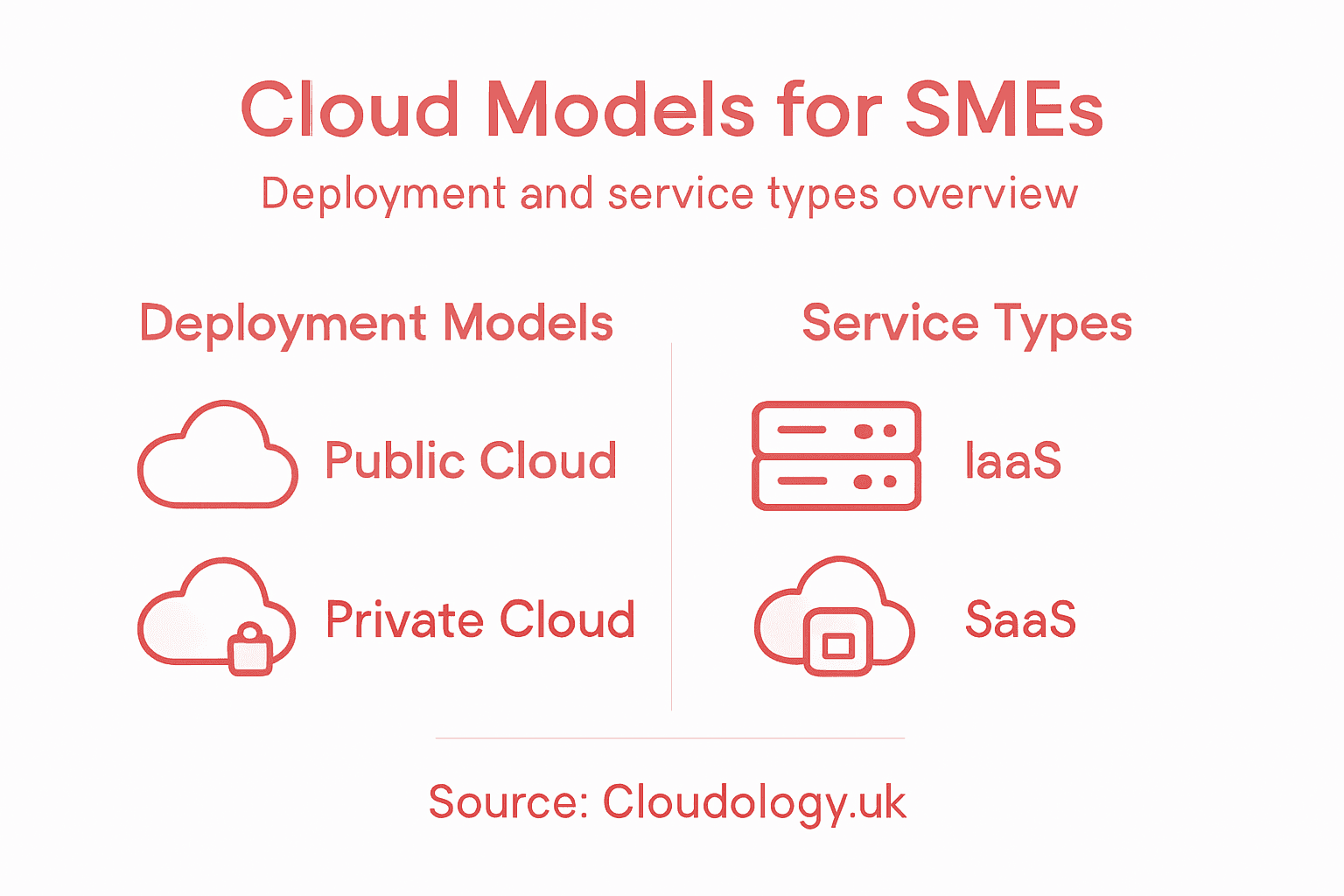
Cloud computing offers multiple deployment models that cater to diverse business requirements, enabling organisations to select an approach that best matches their operational needs and strategic objectives. UK Government cloud guidance identifies four primary deployment models: public, private, hybrid, and community clouds, each presenting unique characteristics and advantages for businesses.
Public cloud platforms represent the most common deployment model, where computing resources are hosted by third-party providers and shared across multiple organisations. These platforms offer significant cost advantages, with businesses paying only for the resources they consume. Private clouds, conversely, provide dedicated infrastructure for single organisations, delivering enhanced security and customisation capabilities. Hybrid cloud models combine public and private cloud environments, allowing businesses to leverage the strengths of both approaches, creating flexible and scalable technological ecosystems.
Here’s a comparison of key cloud deployment models and their distinguishing features for UK businesses:
| Deployment Model | Main Advantage | Typical Use Cases | Security Characteristics |
|---|---|---|---|
| Public Cloud | Cost-effective scalability | Web hosting, SaaS apps | Standard protocols, shared infrastructure |
| Private Cloud | Customisation and control | Financial services, healthcare | Enhanced isolation, tailored policies |
| Hybrid Cloud | Flexible resource allocation | Seasonal workloads, data analytics | Combined controls, policy integration |
| Community Cloud | Shared sector compliance | Research collaborations, public sector | Joint governance, sector standards |
Cloud service types are typically categorised into three primary models: Infrastructure as a Service (IaaS), Platform as a Service (PaaS), and Software as a Service (SaaS). Cloud computing research highlights the distinct characteristics of each service model. IaaS provides fundamental computing infrastructure like virtual machines and storage, PaaS offers development platforms and tools, while SaaS delivers ready-to-use software applications accessible via the internet. Each model provides progressively higher levels of management and abstraction, enabling businesses to select the most appropriate technological solution for their specific requirements.
Pro tip: Conduct a comprehensive assessment of your business’s technological needs, compliance requirements, and budget constraints before selecting a specific cloud deployment and service model.
Compliance and Data Sovereignty Requirements
Data sovereignty represents a critical consideration for UK businesses navigating cloud computing landscapes, encompassing complex legal and regulatory frameworks that govern data storage, processing, and protection. TechUK research emphasises the fundamental principle that data must comply with the legal regulations of its storage location, creating intricate challenges for organisations seeking cloud solutions.
The post-Brexit regulatory environment has significantly intensified data sovereignty complexities for UK enterprises. Businesses must now carefully navigate multiple compliance requirements, including UK General Data Protection Regulation (GDPR), the Data Protection Act, and sector-specific legislative mandates. These regulations dictate stringent protocols for data handling, requiring organisations to implement robust mechanisms that ensure data privacy, security, and territorial compliance. Key considerations include understanding data residency restrictions, implementing appropriate security measures, and maintaining transparent data processing practices.
SME cloud adoption research highlights emerging challenges such as cross-border data transfer restrictions and potential risks associated with international cloud providers. UK businesses must be particularly vigilant about potential exposures under international legislation like the US CLOUD Act, which could compromise data sovereignty. Strategic approaches include selecting cloud providers with UK-based or European data centres, implementing encryption technologies, and developing comprehensive data governance frameworks that anticipate potential regulatory shifts and protect organisational interests.
Pro tip: Conduct a thorough audit of your cloud provider’s data centre locations, compliance certifications, and data handling protocols to ensure complete alignment with UK regulatory requirements.
Financial Impact and Cost Management Strategies
Cloud computing represents a transformative financial approach for UK small and medium enterprises, offering unprecedented opportunities to optimise operational expenditure and reduce traditional IT infrastructure costs. Systematic research demonstrates that approximately 76% of businesses experience substantial cost reductions through strategic cloud service adoption, highlighting the significant economic potential of cloud technologies.

The financial model of cloud computing fundamentally differs from traditional capital-intensive IT investments. Instead of substantial upfront hardware purchases and ongoing maintenance expenses, businesses can leverage pay-as-you-go pricing models that allow granular resource allocation. This approach enables organisations to scale computing resources dynamically, paying only for the precise capacity required. Cost management strategies include implementing robust monitoring tools, establishing clear budget thresholds, and regularly reviewing resource utilisation to prevent unnecessary spending and optimise financial efficiency.
Beyond direct cost savings, cloud computing delivers additional financial benefits through reduced operational overhead. Organisations can eliminate expenses related to physical infrastructure maintenance, hardware upgrades, and dedicated IT personnel. By outsourcing technological infrastructure management, businesses can reallocate financial resources towards core strategic initiatives, driving innovation and competitive advantage. Sophisticated cloud providers offer transparent pricing structures, enabling precise budgeting and financial planning while providing flexibility to adjust resources according to changing business requirements.
Below is a summary of major financial impacts cloud adoption presents for SMEs in the UK:
| Financial Factor | Cloud Approach | Traditional IT Approach | Business Benefit |
|---|---|---|---|
| Initial Investment | Minimal, pay-as-you-go | High upfront costs | Improved cash flow |
| Maintenance | Managed by provider | Internal IT staff needed | Reduced operational burden |
| Scaling Costs | Flexible, per-use pricing | Additional hardware required | Rapid response to growth |
| Budgeting | Detailed, predictable | Variable and complex | Easier financial planning |
Pro tip: Implement automated cloud cost management tools and conduct monthly resource utilisation audits to prevent unexpected expenditure and maintain optimal financial efficiency.
Risks of Cloud Adoption and Security Responsibilities
Cloud security represents a complex landscape of potential vulnerabilities and strategic challenges that UK small and medium enterprises must carefully navigate. Academic research highlights the critical importance of understanding and proactively managing security risks associated with cloud technology adoption, emphasising that comprehensive risk mitigation requires a multifaceted approach.
The primary security risks for SMEs include data breaches, inadequate encryption protocols, and potential non-compliance with regulatory frameworks like UK GDPR. Organisations must implement robust authentication mechanisms, such as multi-factor authentication, and develop comprehensive data protection strategies. These strategies should encompass encryption at rest and in transit, regular security audits, and stringent access control protocols. Critical considerations include protecting sensitive information, maintaining data integrity, and ensuring continuous monitoring of potential security vulnerabilities.
Cloud security responsibilities are shared between organisations and cloud service providers, creating a complex ecosystem of mutual accountability. UK businesses must conduct thorough due diligence when selecting cloud providers, examining their security certifications, data handling practices, and incident response capabilities. Vendor risk management becomes crucial in this context, requiring ongoing assessment of potential security risks and maintaining transparent communication channels with cloud service partners to ensure comprehensive protection against emerging technological threats.
Pro tip: Develop a comprehensive cloud security incident response plan that clearly defines roles, communication protocols, and immediate actions to be taken in the event of a potential security breach.
Unlock the Full Potential of Cloud Technology for Your UK SME
The article highlights critical challenges UK SMEs face with cloud adoption including managing data sovereignty, balancing cost efficiency, and handling complex security responsibilities. If you are striving to achieve scalable, secure, and compliant cloud solutions that align with your unique business needs Cloudology.uk specialises in transforming these challenges into growth opportunities. We understand the importance of flexible deployment models such as public or hybrid cloud alongside effective cost management strategies that prevent overspending while boosting productivity.
Our team at Cloudology.uk offers tailored IT support and secure cloud hosting designed to help you navigate compliance hurdles and mitigate risks. Whether you want to simplify your IT management or develop a robust cloud security strategy we provide comprehensive solutions that empower your business to focus on what matters most. Take the first step towards a future-proof cloud infrastructure by exploring our full range of services on Cloudology.uk and discover how expert guidance can make all the difference. Act now to secure your competitive advantage and future-proof your SME technology environment.
Frequently Asked Questions
What are the primary benefits of using cloud technology for UK SMEs?
Cloud technology enables UK SMEs to access scalable computing resources without hefty upfront investments. It democratises access to enterprise-grade infrastructure, allowing businesses to focus on core operations rather than hardware management.
How does cloud technology impact operational costs for small and medium enterprises?
Cloud computing can significantly reduce operational costs by eliminating the need for expensive hardware purchases and ongoing maintenance. With pay-as-you-go pricing models, SMEs only pay for the resources they use, optimising their financial efficiency.
What are the key deployment models available in cloud computing?
The main deployment models in cloud computing are public, private, hybrid, and community clouds. Each offers unique advantages, such as cost-effectiveness, enhanced security, and flexible resource allocation, catering to various business needs.
How can SMEs ensure compliance with data sovereignty regulations when using cloud services?
To ensure compliance, SMEs should select cloud providers with local or European data centres, understand data residency laws, and implement security measures such as encryption. Regular audits of the cloud provider’s compliance protocols are also essential.
Recommended
- Unleashing the Power of AI: Microsoft 365 Empowering Small Businesses – Cloudology
- Case Studie Single – Cloudology
- The Backbone of Business: The Critical Role of Reliable Internet Connectivity – Cloudology
- Staying Competitive: Why Businesses Must Invest in High-Quality Internet Solutions – Cloudology
- Role of Accountancy for Growth – Impact on Business Success