

Nearly nine out of ten british small and medium-sized businesses now trust cloud solutions for daily operations. The demand for reliable cloud services grows fast as IT decision-makers weigh productivity gains against the reality of ongoing data security risks. This article reveals what defines true cloud solutions, exposes widespread myths, and explains how modern cloud platforms can help global businesses stay agile and safe in an uncertain world.
Table of Contents
- Defining Cloud Solutions and Common Myths
- Types of Cloud Services for Modern SMEs
- Key Benefits: Flexibility, Scalability, and Cost
- Security, Compliance, and Data Protection Standards
- Comparing Cloud with On-Premises IT Systems
- Common Challenges and Making the Right Choice
Key Takeaways
| Point | Details |
|---|---|
| Understanding Cloud Solutions | Cloud computing offers flexible, scalable resources without high initial costs, but businesses must assess risks like supply chain security and data sovereignty. |
| Types of Cloud Services | SMEs benefit from IaaS, PaaS, and SaaS, each providing unique advantages such as reduced hardware investment and rapid application deployment. |
| Benefits of Cloud Computing | Key advantages include flexibility, scalability, and cost-effectiveness, allowing organisations to adapt quickly to market changes and improve operational efficiencies. |
| Challenges of Cloud Migration | Effective cloud adoption requires addressing technological complexity and security concerns, necessitating a phased migration strategy to ensure seamless integration. |
Defining Cloud Solutions and Common Myths
Cloud computing represents a transformative approach to managing technological infrastructure, enabling businesses to access powerful computational resources without substantial upfront investments. Cloud solutions provide a flexible network of shared computing resources that can be rapidly provisioned and scaled according to organisational needs.
At its core, cloud computing involves shared networked hardware and software resources managed by specialised providers and accessible globally. The public cloud model offers significant economic advantages through infrastructure cost sharing across multiple users. Key characteristics include on-demand self-service, broad network access, resource pooling, rapid elasticity, and measured service delivery. These foundational attributes distinguish cloud solutions from traditional local computing infrastructure.
However, several persistent myths can obscure understanding of cloud technology. Contrary to popular belief, cloud solutions are not universally free from supply chain risks or immune to geopolitical pressures. Businesses must recognise that data sovereignty, cybersecurity, and provider transparency are critical considerations. Cloud providers face ongoing challenges from global political dynamics and potential cyberattacks, requiring robust security protocols and continuous risk management.
Pro tip: Before selecting a cloud solution, conduct a comprehensive risk assessment that evaluates provider security credentials, data protection policies, and compliance with industry-specific regulatory requirements.
Types of Cloud Services for Modern SMEs
Cloud computing has revolutionised how small and medium-sized enterprises (SMEs) approach technological infrastructure, offering flexible and scalable IT resources through diverse service models that can dramatically transform business operations. These cloud service models provide organisations with unprecedented adaptability and cost-effectiveness.
The primary cloud service models can be categorised into three fundamental types: Infrastructure as a Service (IaaS), Platform as a Service (PaaS), and Software as a Service (SaaS). IaaS provides virtualised computing resources, allowing businesses to rent virtual machines, storage, and networking infrastructure without investing in physical hardware. PaaS offers development platforms where organisations can build, test, and deploy applications without managing underlying infrastructure complexities. SaaS delivers fully functional software applications accessed via internet subscription, eliminating the need for local software installation and maintenance.
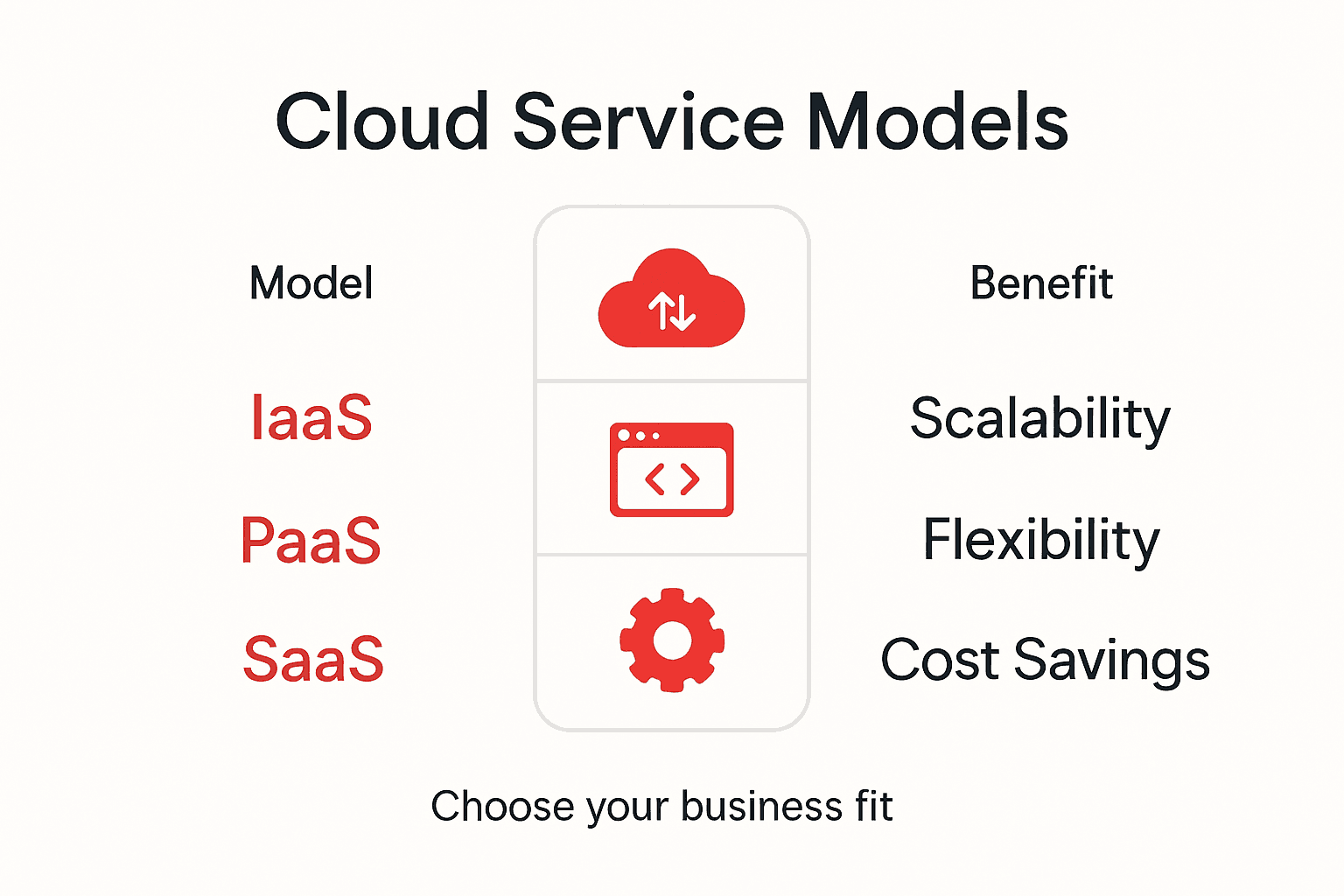
Each cloud service model presents unique advantages for SMEs. IaaS enables rapid scaling of computational resources, PaaS accelerates application development by providing pre-configured environments, and SaaS offers immediate access to sophisticated software tools with minimal technical overhead. These models support critical business needs such as enhanced collaboration, improved data accessibility, reduced IT management burden, and substantial cost savings compared to traditional on-premises infrastructure.
Here is a summary of the three main cloud service models and their business impact:
| Service Model | Core Functionality | Typical Business Use | Key Advantage |
|---|---|---|---|
| Infrastructure as a Service (IaaS) | Provides virtual servers, storage and networking | Hosting databases, disaster recovery, scalable resources | Reduces hardware investment |
| Platform as a Service (PaaS) | Supplies development tools and environments | Building and deploying applications, coding platforms | Speeds up development cycle |
| Software as a Service (SaaS) | Offers access to ready-to-use software | Email, CRM, collaboration tools | Minimises IT maintenance and updates |
Pro tip: When selecting cloud services, conduct a comprehensive assessment of your specific business requirements, considering factors like scalability, security compliance, budget constraints, and potential integration with existing technological ecosystems.
Key Benefits: Flexibility, Scalability, and Cost
Cloud computing represents a transformative technological approach that delivers substantial strategic advantages for modern businesses, enabling dynamic resource allocation and operational agility through innovative service models. These solutions fundamentally reimagine how organisations manage technological infrastructure and respond to changing market demands.

The core benefits of cloud solutions centre on three critical dimensions: flexibility, scalability, and cost-effectiveness. Flexibility allows businesses to rapidly deploy and customise applications, ensuring swift market responsiveness. Scalability enables organisations to dynamically adjust computational resources precisely matching current operational requirements, eliminating traditional infrastructure constraints. This means businesses can seamlessly increase or decrease technological capacity without substantial capital investments, creating an adaptive and responsive technological ecosystem.
From a financial perspective, cloud computing transforms traditional IT expenditure models. Instead of substantial upfront hardware investments, businesses can leverage pay-as-you-go service structures, paying exclusively for consumed resources. This approach dramatically reduces initial capital expenditure, converts fixed technological costs into variable operational expenses, and provides granular control over IT budgeting. Small and medium enterprises particularly benefit from this model, gaining access to enterprise-grade technological capabilities without prohibitive financial barriers.
Pro tip: Conduct a comprehensive audit of your current IT infrastructure and anticipated growth projections before migrating to cloud services, ensuring you select a solution that precisely matches your organisation’s unique technological and budgetary requirements.
Security, Compliance, and Data Protection Standards
Cloud computing requires robust security frameworks that protect organisational data and maintain regulatory compliance, addressing critical challenges through advanced technological strategies. The complex landscape of digital security demands comprehensive approaches that safeguard sensitive information while enabling efficient technological operations.
Effective cloud security encompasses multiple strategic dimensions, including advanced encryption protocols, multi-factor authentication, and continuous monitoring systems. These technical measures create sophisticated defensive layers that prevent unauthorised access, detect potential security breaches, and ensure data integrity. International standards such as ISO 27001 and NIST guidelines provide crucial benchmarks for implementing rigorous security practices, offering organisations structured frameworks to evaluate and enhance their digital protection mechanisms.
Navigating regulatory compliance requires a holistic approach integrating technological solutions with organisational policies. Businesses must implement comprehensive identity management systems, develop granular access controls, and maintain detailed audit trails of data interactions. The integration of artificial intelligence and machine learning technologies further enhances threat detection capabilities, enabling proactive identification and mitigation of potential security risks before they can compromise sensitive information systems.
Pro tip: Conduct regular security assessments, maintain updated compliance documentation, and invest in continuous staff training to create a robust, adaptive approach to cloud security and regulatory adherence.
Comparing Cloud with On-Premises IT Systems
Organisations today face a critical strategic decision when evaluating technological infrastructure, comparing the nuanced trade-offs between on-premises and cloud computing systems. Each approach offers distinct advantages and challenges that directly impact operational efficiency, financial performance, and technological adaptability.
On-premises IT systems represent the traditional technological model, characterised by local physical infrastructure and complete organisational control. These systems provide exceptional customisation opportunities and offer comprehensive data sovereignty, making them particularly attractive for businesses with highly specialised or sensitive technological requirements. However, they demand substantial upfront capital investments, require dedicated IT personnel for ongoing maintenance, and often struggle to adapt quickly to evolving technological landscapes.
Cloud computing, by contrast, introduces a transformative approach to technological infrastructure. This model leverages remote servers managed by specialised providers, offering unprecedented flexibility, scalability, and cost-efficiency. Businesses can access advanced technological resources through pay-as-you-go models, eliminating significant capital expenditures and enabling rapid deployment of sophisticated IT solutions. The primary trade-offs include potential vendor dependency, reduced direct control over infrastructure, and increased reliance on internet connectivity for seamless operations.
The following table compares typical differences between on-premises IT systems and cloud computing:
| Aspect | On-Premises IT | Cloud Computing | Business Outcome |
|---|---|---|---|
| Initial Cost | High capital investment | Subscription/pay-as-you-go | Lower barriers to entry |
| Flexibility | Changes are slow | Rapid scalability | Quick adaptation to needs |
| Control | Full organisational control | Limited direct control | Depends on vendor capabilities |
| Maintenance | Requires in-house IT staff | Outsourced to provider | Reduced internal workload |
Pro tip: Conduct a comprehensive audit of your organisation’s technological requirements, workload characteristics, and long-term strategic goals before selecting between on-premises and cloud solutions to ensure optimal technological alignment.
Common Challenges and Making the Right Choice
Cloud migration represents a complex strategic decision with multifaceted considerations, requiring comprehensive analysis of organisational information security and privacy challenges. Businesses must navigate a nuanced landscape of technological opportunities and potential risks to ensure successful digital transformation.
The primary challenges in cloud adoption centre around three critical dimensions: technological complexity, security concerns, and operational integration. Information security remains a paramount consideration, with organisations facing significant barriers related to data protection, regulatory compliance, and maintaining robust cybersecurity protocols. Skill shortages within internal technical teams further compound these challenges, necessitating strategic approaches to knowledge acquisition and continuous professional development.
Successful cloud migration demands a holistic decision-making framework that evaluates multiple potential deployment models. Public, private, and hybrid cloud environments each present unique advantages and limitations, requiring organisations to conduct thorough assessments of their specific operational requirements, technological infrastructure, and long-term strategic objectives. Key considerations include assessing current infrastructure maturity, understanding potential cost implications, evaluating vendor capabilities, and developing comprehensive risk mitigation strategies that align with organisational goals.
Pro tip: Develop a phased cloud migration strategy that includes pilot testing, incremental implementation, and continuous performance monitoring to minimise operational disruptions and validate technological investments.
Empower Your Business with Tailored Cloud Solutions
Businesses face complex challenges when transitioning to cloud technology such as ensuring security compliance, managing costs, and achieving seamless operational integration. The article highlights key pain points like balancing flexibility with risk and selecting the optimal cloud deployment model for scalable growth. If you seek to overcome these hurdles and leverage the full advantage of cloud computing, clear expert guidance is essential.
At Cloudology.uk, we deliver comprehensive IT and cloud hosting solutions designed specifically for SMEs aiming for agility, security, and cost-effectiveness. Our services simplify IT management, protect your data with robust security measures, and ensure your technology evolves with your business needs. Experience the confidence of a trusted IT partner who understands the critical importance of data protection and compliance in modern cloud infrastructures.
Take the next step in safeguarding and scaling your business technology by exploring our expert cloud hosting services.
Start your cloud journey today with Cloudology. Visit Cloudology.uk to speak with our specialists and discover tailored solutions that empower your business success.
Frequently Asked Questions
What are the main benefits of using cloud solutions for my business?
Cloud solutions offer flexibility, scalability, and cost-effectiveness, allowing businesses to adapt to changing demands without substantial upfront investments in hardware.
How do cloud services differ from traditional on-premises IT systems?
Cloud services use remote servers managed by providers, providing advantages such as lower initial costs and rapid scalability, whereas on-premises systems require significant capital investment and in-house maintenance.
What types of cloud service models are available?
The main cloud service models are Infrastructure as a Service (IaaS), Platform as a Service (PaaS), and Software as a Service (SaaS), each offering unique functionalities tailored to different business needs.
What security measures should I consider when migrating to cloud solutions?
Important security measures include advanced encryption protocols, multi-factor authentication, regular security assessments, and compliance with regulatory standards to protect sensitive organisational data.