

Ripping out outdated copper wires and wrestling with rigid phone contracts can frustrate any IT manager striving to keep costs down and teams connected. For British small and medium businesses, switching to VoIP telephony promises a new level of flexibility and savings by routing calls securely over Internet connections rather than traditional phone lines. This guide breaks down what VoIP really means for your infrastructure, dispelling old reliability myths and highlighting how modern systems deliver both clarity and control as the UK moves away from legacy networks.
Table of Contents
- VoIP Telephony Defined and Debunked
- Key VoIP Features and Varieties Explained
- Business Benefits of Adopting VoIP Solutions
- Comparing VoIP to Traditional Phone Systems
- Potential Challenges and Security Considerations
Key Takeaways
| Point | Details |
|---|---|
| Cost Efficiency | VoIP can reduce communication costs significantly, offering savings of 30-50% for SMEs by eliminating separate phone line bills. |
| Scalability | Adding or removing users in a VoIP system is seamless, allowing businesses to adapt rapidly without complex installations. |
| Diverse Features | VoIP systems provide advanced functionalities like video conferencing and automated attendants that enhance team communication compared to traditional systems. |
| Security Measures | Proper configuration with encryption, firewalls, and user training is crucial to mitigate security risks associated with VoIP technology. |
VoIP Telephony Defined and Debunked
Voice over Internet Protocol (VoIP) is fundamentally a method of transmitting voice communications across broadband internet connections instead of relying on traditional circuit-switched phone lines. Rather than using copper wires and telephone exchanges, VoIP converts your voice into digital packets that travel across the internet to their destination, where they’re converted back into sound. This shift from hardware-based infrastructure to internet-based systems underpins why VoIP offers such different economics for UK businesses. The Internet Telephony Service Providers Association defines VoIP as a networked and international technology capable of delivering significant cost savings and new service functionalities compared to traditional telephony.
Now here’s where reality diverges from outdated perceptions. When VoIP first emerged in the late 1990s, sceptics voiced legitimate concerns. The technology was unreliable, emergency services couldn’t always locate callers, and call quality often sounded like two people talking through tin cans. These were genuine problems. However, technological advances and industry standards have resolved most of these early limitations. Modern VoIP delivers improved reliability and service quality whilst being subject to robust regulatory frameworks ensuring consumer protection. Your calls today won’t cut out unexpectedly, emergency services have proper location data, and call clarity rivals traditional phone lines. Regulatory bodies like Ofcom now treat VoIP providers with the same rigorous standards as conventional telecom companies, which means you receive equivalent safeguards.
What makes VoIP particularly relevant for IT managers at SMEs is that the technology works transparently. Your users pick up a handset, dial as normal, and make calls exactly like they would on an old PBX system. The difference operates entirely behind the scenes. Whether you’re running a contact centre with multiple sites or a distributed team across the UK, VoIP handles call routing, voicemail, conference calling, and call transfers through software rather than expensive hardware. This flexibility means your communication system can adapt as your business grows without requiring new telephone exchanges or running new phone lines through your building. Understanding this distinction between the technical mechanism and the user experience helps explain why so many UK businesses have quietly switched over the past decade.
Pro tip: When evaluating VoIP for your organisation, request trial deployments with a subset of users first rather than committing to a full rollout immediately. This approach lets your team experience the technology firsthand and identify any integration needs with your existing systems before scaling organisation-wide.
Key VoIP Features and Varieties Explained
VoIP systems offer a wealth of features that traditional phone systems simply cannot match. The core technical advantage lies in how VoIP converts voice into digital packets transmitted over IP networks, allowing for efficient compression and flexible routing. Beyond this foundation, you get practical capabilities that reshape how your team communicates. Call forwarding automatically redirects incoming calls to mobile phones or alternative locations, meaning your staff stays reachable whether they’re at their desk or working remotely. Voicemail arrives as audio files you can access through apps rather than logging into a separate system. Automated attendants greet callers and route them to the right department without a receptionist lifting a finger. Video calling, HD voice quality, and call analytics let you monitor communication patterns and identify training opportunities. These features integrate directly into your existing business tools, so a call can trigger a customer record to pop up on screen automatically.
Understanding the different deployment models helps you choose what suits your organisation. Hosted VoIP services run entirely in the cloud, meaning Cloudology manages the infrastructure, updates, and maintenance on your behalf. You simply connect your phones and extensions work immediately. This approach minimises your IT overhead since there’s no equipment to install or maintain on-site. On-premises VoIP puts the phone system directly in your office, giving you greater control over configurations and security policies. This suits larger organisations with complex requirements or those with strict data residency needs. Many UK businesses fall somewhere between these options, using a hybrid approach where they maintain control over critical systems whilst leveraging cloud connectivity for flexibility. VoIP deployment options include cloud-based systems and on-premises solutions, each offering distinct advantages depending on your business size and requirements.
The physical devices you choose also matter. Traditional desk phones remain popular because staff need no training, but modern VoIP phones include screens, programmable buttons, and wireless connectivity that boost productivity. Software-based applications on computers and smartphones turn any device into a phone, perfect for remote workers or field teams. VoIP adapters can convert your existing traditional phones to work over internet connections, letting you preserve equipment investments whilst migrating to VoIP infrastructure. Different codecs optimise voice quality based on available bandwidth. In offices with robust broadband, you get crystal-clear conversations. Locations with limited bandwidth use compression codecs that reduce file sizes without noticeably degrading call quality. Your provider should support multiple codecs to adapt as network conditions change.
Pro tip: Before selecting a VoIP system, audit your current internet connectivity and ensure adequate bandwidth capacity; most providers recommend 100 kilobits per second per concurrent call, so test with a small pilot group first to verify your actual network performance under real-world call volumes.
Business Benefits of Adopting VoIP Solutions
The financial case for VoIP starts with what you stop paying. Traditional phone systems lock you into per-line costs, long-distance charges that accumulate quickly, and hardware maintenance contracts. VoIP consolidates all these expenses into a single monthly subscription based on your user count and features. Since voice travels over your existing internet connection, you eliminate separate phone line bills entirely. A typical UK SME with ten staff members might save between 30 and 50 percent on communication costs within the first year. That saving compounds annually. Beyond the obvious line-item reductions, VoIP delivers cost efficiency through unified communication infrastructure that reduces the IT overhead of managing separate systems. No more replacing aging PBX equipment every seven years or paying technicians to rewire your office when someone moves desks. The cost argument alone justifies consideration, but the operational benefits prove equally compelling.

Scalability represents perhaps the most underrated advantage. Your current phone system likely costs the same whether you employ eight people or eighteen because you’ve already invested in the infrastructure. Adding a new VoIP user costs virtually nothing. You provision an extension, assign it to a handset or application, and they’re operational within minutes. This flexibility means you can hire contractors, bring on seasonal staff, or open a satellite office without complex telecommunications planning. Remote workers connect using exactly the same system as office-based employees, creating consistency across your organisation. If your business experiences rapid growth, VoIP adapts without requiring capital expenditure or lengthy installation projects. If circumstances demand contraction, you reduce subscriptions immediately rather than carrying unused phone lines.
Productivity improvements emerge once staff experience the technology firsthand. Call forwarding means your team remains reachable everywhere, reducing missed opportunities and improving customer responsiveness. Voicemail-to-email transcription lets managers review messages without hunting for the phone. Integrated dialling from your CRM system means calling a client requires one click rather than manually entering digits. Video conferencing eliminates travel time for meetings with distant colleagues or clients. Enhancing business mobility with VoIP transforms how distributed teams collaborate, particularly for organisations where staff split time between offices, customer sites, and home working. Call recording and analytics reveal communication patterns, highlight training needs, and support dispute resolution. These capabilities compound into measurable efficiency gains that typically appear within months of deployment.
Risk reduction often goes unmentioned but carries significant weight. VoIP providers maintain redundant systems with automatic failover, meaning your communications continue even during local infrastructure issues. Your system automatically routes calls through backup connections without manual intervention. Data centres in geographically dispersed locations ensure continuity regardless of regional outages. Compare this to traditional phone systems where a single hardware failure means your entire phone infrastructure goes offline. Business continuity planning becomes simpler because your critical communication system has built in resilience your old infrastructure never offered.
Pro tip: Calculate your total cost of ownership before and after VoIP by including line rentals, long-distance charges, hardware maintenance, technician time, and capital equipment purchases; most organisations discover they recoup the migration costs within six to nine months, making it one of the quickest payback technology investments available.
Comparing VoIP to Traditional Phone Systems
Traditional phone systems rely on copper networks that route calls through physical infrastructure installed decades ago. These systems were designed when businesses needed static, fixed locations with permanent desk phones. Every employee required a dedicated phone line, every office needed complex wiring, and expansion meant expensive installation visits. The technology delivers reliability within its design parameters, but those parameters feel increasingly rigid in modern business environments. Contrast this with VoIP, which transmits calls over your internet connection using software-based infrastructure. The comparison becomes clearer when you examine what actually happens behind the scenes. Traditional systems require ongoing maintenance contracts for legacy equipment, replacement parts that grow scarcer annually, and technician visits for routine changes. VoIP requires internet connectivity and a compatible phone or application, nothing more. When your needs shift, you adjust settings within software rather than calling an engineer to rewire your building.
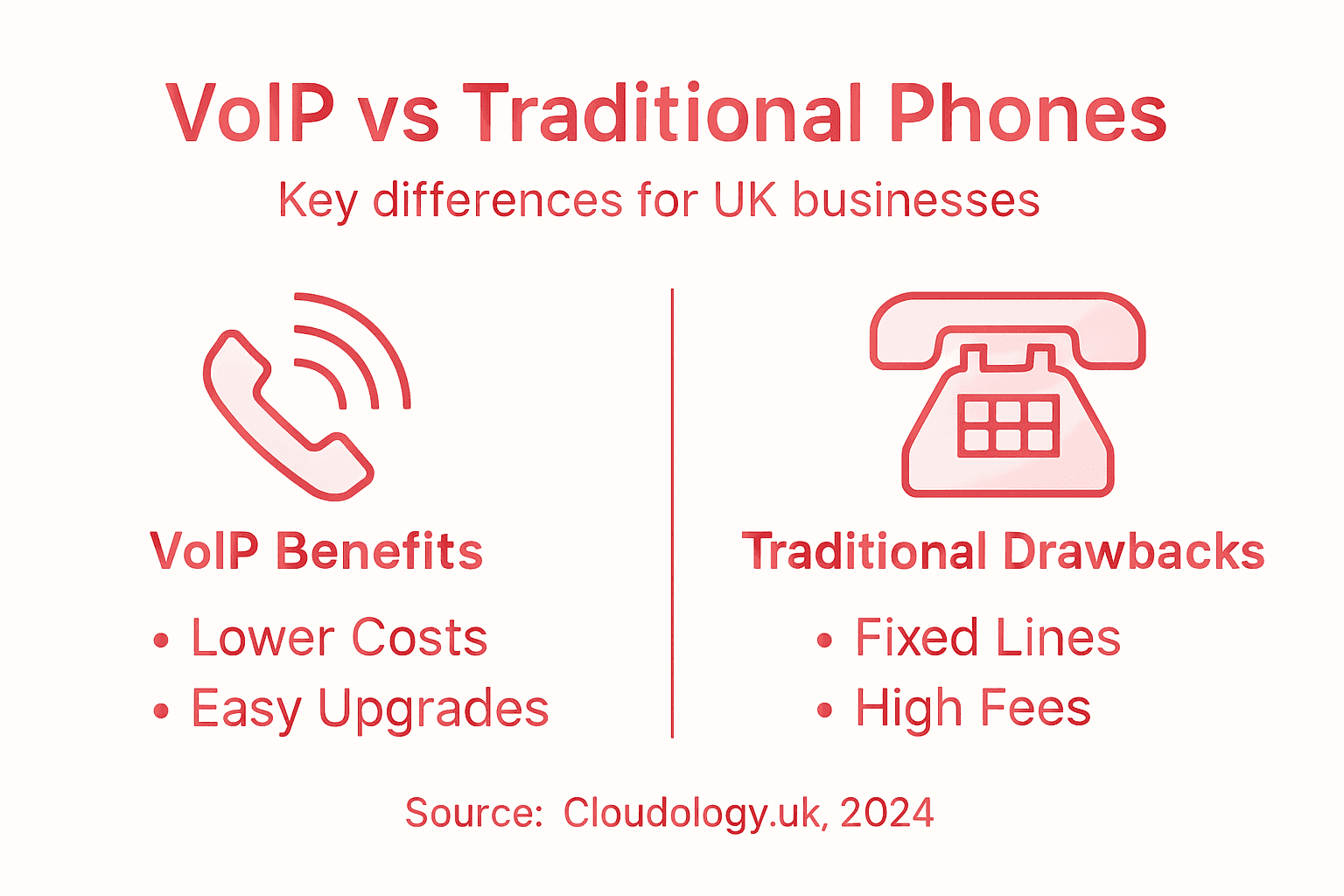
The timeline for traditional copper networks adds urgency to this comparison. The UK is systematically phasing out older analogue telephone infrastructure, with the bulk of this transition completing by 2027. This deadline means organisations still using traditional landlines face a forced migration regardless of their preferences. Waiting until 2027 to act creates unnecessary pressure and limits your negotiating position with suppliers. Switching to VoIP services before traditional networks are retired allows you to manage the transition on your own schedule with time to train staff and optimise your system. You control the timing rather than being herded along with thousands of other businesses scrambling to migrate simultaneously.
Feature capability reveals another fundamental difference. Traditional systems offer basic functions: answer calls, transfer calls, voicemail. VoIP systems provide integrated video conferencing, call recording with automatic transcription, presence indicators showing staff availability, unified messaging combining voicemail and email, and direct integration with your business applications. A traditional system treats your phone as an isolated device disconnected from your other tools. VoIP treats communication as part of your broader business technology ecosystem. Your CRM can display a customer record when they call. Your calendar can block your phone as unavailable during meetings. Your mobile phone becomes a full extension with identical features to office phones. These capabilities transform communication from a separate utility into an integrated business function.
Reliability concerns about VoIP dependency on internet connectivity deserve honest examination. If your broadband fails, VoIP stops working. However, modern implementations address this through dual connectivity, with backup mobile hotspots or secondary broadband links ensuring continuity. Traditional systems also failed during power outages, though this vulnerability often went unmentioned. VoIP providers maintain geographically distributed data centres with automatic failover, whereas your local phone exchange represented a single point of failure. Current broadband infrastructure in UK business districts proves highly reliable, with service level agreements guaranteeing 99.9 percent uptime from reputable providers. When you weigh the flexibility, features, cost savings, and future proofing that VoIP provides against minor connectivity concerns, the balance tips decisively toward VoIP for most organisations.
Pro tip: Before making your migration decision, conduct a side-by-side cost comparison that includes your current copper line rental, long-distance charges, equipment maintenance fees, and anticipated VoIP subscription costs; most organisations discover the five-year total cost of ownership strongly favours VoIP, particularly when factoring in the one-time migration costs.
Here’s a clear summary of key differences between VoIP and traditional phone systems for UK businesses:
| Aspect | VoIP Telephony | Traditional Phone Systems |
|---|---|---|
| Infrastructure | Internet-based; software driven | Copper wiring; hardware dependent |
| Scalability | Add/remove users instantly | Expansion requires new lines |
| Feature Integration | Combines with apps and analytics | Limited functions; stand-alone |
| Cost Structure | Monthly subscription; lower maintenance | Line rental; higher ongoing costs |
| Business Continuity | Cloud failover; geographic redundancy | Localised outages halt all calls |
Potential Challenges and Security Considerations
VoIP introduces security vulnerabilities that differ from traditional phone systems because voice now travels across the same networks as your email, financial data, and customer information. Attackers recognise this convergence as an opportunity. Eavesdropping becomes possible when calls traverse unencrypted connections, meaning someone with network access could intercept your conversations. Phishing attacks target VoIP users through misleading emails or messages designed to steal login credentials, granting attackers access to your entire phone system. Denial of service attacks flood your connection with traffic, rendering both your phones and internet unusable simultaneously. SPIT (spam over internet telephony) inundates staff with unwanted robotic calls, reducing productivity and creating frustration. These aren’t theoretical risks. VoIP security requires encryption and strong authentication mechanisms to mitigate these threats effectively. The good news is that modern VoIP systems address these vulnerabilities through built-in protections when properly configured.
Beyond security threats, VoIP performance depends entirely on your network infrastructure. Quality of service degradation occurs when bandwidth becomes scarce or packet loss increases. Imagine attempting a crucial client call whilst someone streams video simultaneously on your office network. Call quality deteriorates noticeably, creating an unprofessional impression. Power availability represents another consideration that catches organisations off guard. If your broadband router or VoIP equipment loses power, your phone system goes offline immediately. Traditional phone systems often included backup power supplies, but this requirement needs explicit planning with VoIP. Comprehensive security measures including firewalls and intrusion detection systems become necessary to maintain secure, high-quality voice communications in modern business environments. Your IT infrastructure must evolve alongside your communication system.
Implementing effective defences requires a layered approach. Encryption protects calls from eavesdropping during transmission. Strong passwords and multi-factor authentication prevent unauthorised account access. Firewalls separate your VoIP system from the public internet, allowing only legitimate traffic. Regular software updates patch vulnerabilities as they emerge. User training teaches staff to recognise phishing attempts and suspicious requests. Network segmentation isolates critical communication infrastructure from general office traffic. Backup internet connectivity ensures continuity during outages. These measures sound complex, but most modern VoIP providers build them into their systems automatically. Your responsibility focuses on configuration, user discipline, and maintaining adequate network infrastructure. When managed properly, VoIP actually improves security by centralising communication infrastructure under professional oversight rather than leaving it to age in-place like traditional systems.
The bandwidth question deserves specific attention. Each VoIP call requires roughly 100 kilobits per second under typical conditions. A modern business broadband connection typically provides 60 to 150 megabits per second, supporting dozens of simultaneous calls comfortably. However, this capacity gets consumed by everything else using your internet connection. Video conferencing, cloud backups, and SaaS applications all compete for the same bandwidth. Plan accordingly by assessing your maximum concurrent call volume and ensuring your broadband provider offers sufficient capacity with guaranteed service levels. Redundant internet connections from different providers provide failover protection if your primary link fails.
Pro tip: Before deploying VoIP, conduct a comprehensive network audit including bandwidth testing during peak usage times, power infrastructure assessment for your router and VoIP equipment, and security policy review with your IT team; this groundwork prevents costly problems after implementation and ensures your infrastructure can handle the demands your new communication system creates.
Review this overview of typical VoIP security and resilience measures:
| Security Risk | VoIP Mitigation Strategy | Business Protection Benefit |
|---|---|---|
| Eavesdropping | Encryption of calls | Prevents unauthorised access |
| Phishing Attacks | Multi-factor authentication | Safeguards user credentials |
| Denial of Service | Firewalls, network monitoring | Maintains call uptime and quality |
| Power Interruptions | Backup power, failover links | Ensures continuous communications |
| SPIT (Spam Calls) | Robust filtering technology | Reduces unwanted disruptions |
Unlock Seamless Communication for Your UK Business with Cloudology
The challenges outlined in “Why Use VoIP Telephony for UK Businesses” highlight the urgent need for reliable, scalable, and secure communication systems. If you are feeling the pressure of rising costs, inflexible phone infrastructure, or concerns about future-proofing your telephony, you are not alone. Many UK SMEs seek smarter solutions that integrate effortlessly with existing IT systems while enhancing productivity and safeguarding business continuity. VoIP telephony offers transformative benefits, but only with the right support and configuration.
At Cloudology, we specialise in tailoring VoIP telephony solutions that directly address these pain points. Our expertise helps you transition smoothly away from costly and outdated copper networks towards modern internet-based communication. Benefit from crystal-clear calls, flexible user management, and robust security measures designed for your specific needs. Explore our insights through the Uncategorized Archives – Cloudology to deepen your understanding of how VoIP can reshape your business communications.
Take control of your organisation’s future communication today. Visit Cloudology.uk to discover how our professional IT services simplify your move to VoIP with expert advice, customised deployment, and ongoing support. Don’t wait for the 2027 analogue switch-off pressure. Act now to boost your business agility, reduce costs, and ensure uninterrupted communications with a partner you can trust.
Frequently Asked Questions
What is VoIP telephony?
Voice over Internet Protocol (VoIP) is a technology that allows for voice communications to be transmitted over broadband internet connections by converting voice into digital packets.
What are the main advantages of using VoIP for businesses?
VoIP offers significant cost savings, scalability, improved communication features, and flexibility, allowing businesses to adapt their communication systems in line with growth without the need for expensive hardware.
How do VoIP systems compare to traditional phone systems?
VoIP systems run on an internet-based network and provide more advanced features, scalability, and cost-efficiency compared to traditional phone systems, which rely on older copper wiring and offer limited functionality.
Are there security concerns with VoIP telephony?
Yes, VoIP can introduce security vulnerabilities such as eavesdropping and denial of service attacks; however, these risks can be mitigated through encryption, strong authentication, and other security measures.