

Managing IT infrastructure for a growing business often means facing unpredictable peaks and sudden changes in demand. For UK small and medium enterprises, understanding cloud scalability is crucial for staying agile without overspending on hardware. Cloud solutions now allow you to adjust resources easily and cost-effectively, challenging the old idea that scaling only means buying more servers. Learning how modern scalability really works will help you turn your IT setup into a flexible tool that drives your digital transformation.
Table of Contents
- Defining Cloud Scalability And Common Misconceptions
- Types Of Cloud Scalability For Business Needs
- How Cloud Scalability Works In Practice
- Key Benefits For UK Smes Embracing Scalability
- Risks, Costs, And Common Pitfalls For Smes
- Choosing The Right Cloud Scalability Approach
Key Takeaways
| Point | Details |
|---|---|
| Understanding Cloud Scalability | Cloud scalability enables businesses to dynamically adjust computing resources, optimising performance and controlling costs. It is crucial to view it as flexible resource management rather than merely adding hardware. |
| Types of Scaling Strategies | Vertical scaling enhances existing server capabilities, while horizontal scaling adds servers for workload distribution. Choosing the right strategy depends on business growth patterns and resource requirements. |
| Benefits for SMEs | Scalable cloud solutions provide operational agility and financial flexibility, allowing SMEs to respond quickly to market changes and only pay for the resources they use. |
| Risks and Considerations | While adopting cloud scalability can lead to significant advantages, organisations must be mindful of potential financial risks and technical complexities that can arise without proper planning and monitoring. |
Defining Cloud Scalability and Common Misconceptions
Cloud scalability represents a technological approach that enables businesses to dynamically adjust their computing resources based on fluctuating demand. At its core, cloud scalability goes far beyond simply adding more hardware; it is a sophisticated mechanism for flexible resource management that allows organisations to optimise performance and control costs.
For UK small and medium enterprises (SMEs), cloud scalability means having the ability to quickly expand or contract computing infrastructure without significant upfront investments. This capability allows businesses to respond rapidly to market changes, handle sudden traffic spikes, and maintain consistent performance. Traditional misconceptions often suggest that scaling simply involves purchasing more servers or increasing computing power, but modern cloud solutions offer much more nuanced approaches that integrate intelligent resource allocation, automated provisioning, and cost-efficient infrastructure management.
The key aspects of cloud scalability include vertical scaling (increasing resources within a single server), horizontal scaling (adding more servers to distribute workload), and dynamic scaling (automatically adjusting resources in real-time). These approaches provide UK SMEs with unprecedented flexibility, enabling them to manage computing resources with precision and strategic intent. By understanding these principles, businesses can transform their technological infrastructure from a static cost centre into a responsive, adaptable system that supports growth and innovation.
Pro tip: When exploring cloud scalability options, always conduct a comprehensive workload analysis to determine the most appropriate scaling strategy for your specific business requirements.
Types of Cloud Scalability for Business Needs
Cloud scalability for UK businesses primarily encompasses two fundamental approaches: vertical scaling and horizontal scaling. Cloud infrastructure design allows organisations to choose between these strategies based on specific operational requirements and growth trajectories.
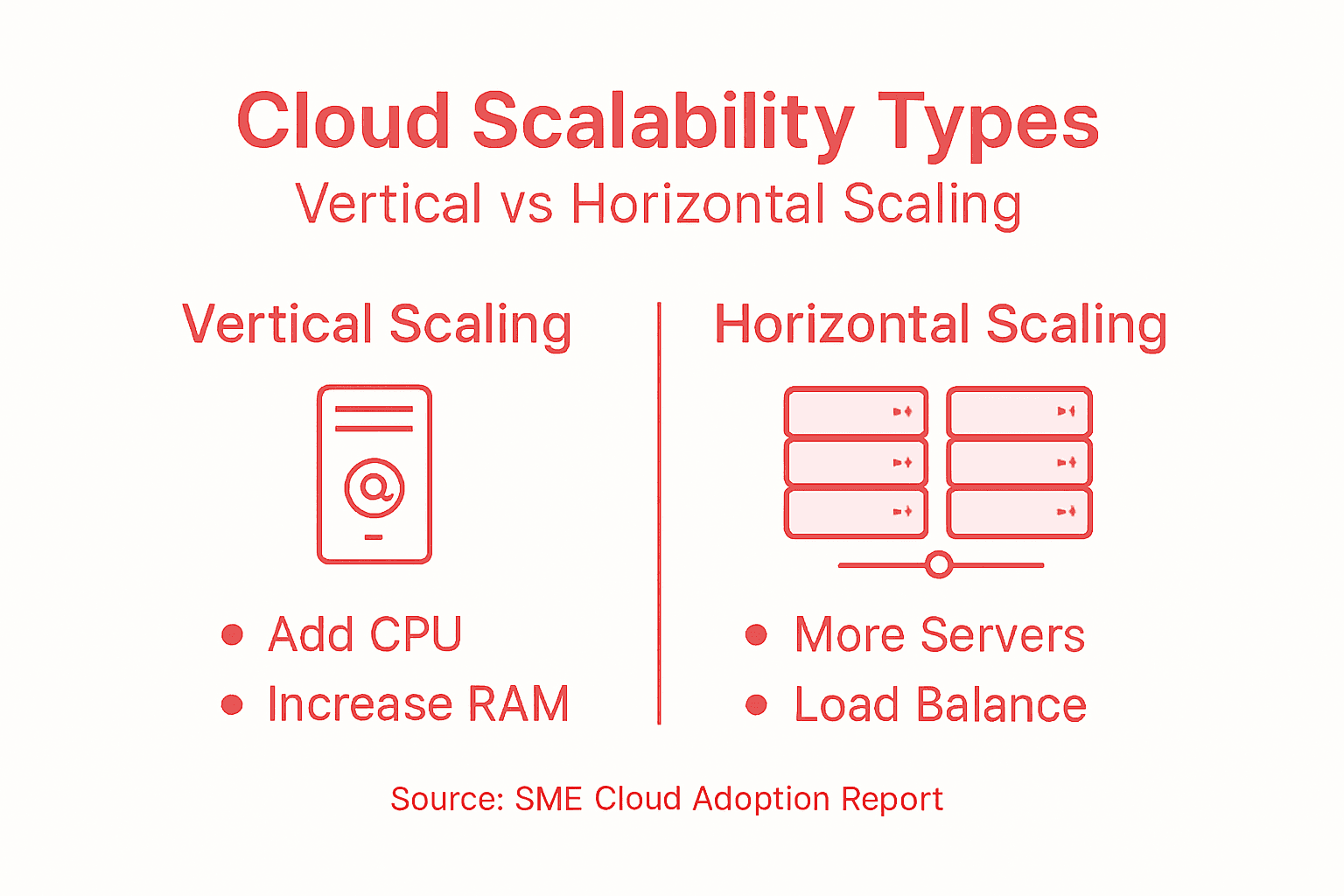
Vertical scaling involves enhancing the capabilities of existing servers by increasing computational resources such as CPU, RAM, or storage capacity. This approach is particularly suitable for businesses with predictable, steady growth patterns where a single server can be upgraded to handle increased workloads. Small to medium enterprises often start with vertical scaling as it requires minimal infrastructure changes and provides a straightforward method of expanding computing power without significant architectural modifications.
Horizontal scaling offers a more dynamic approach by adding multiple servers to distribute workloads across different machines. This method provides greater resilience and flexibility, enabling businesses to handle sudden traffic spikes and complex computational tasks. By spreading resources across multiple servers, organisations can achieve higher performance levels, improved redundancy, and more efficient load balancing. The ability to add or remove servers dynamically makes horizontal scaling an attractive option for businesses experiencing rapid or unpredictable growth patterns.
To clarify the main scaling strategies, here is a concise comparison for UK SMEs:
| Criterion | Vertical Scaling | Horizontal Scaling |
|---|---|---|
| Infrastructure change | Upgrade existing server | Add more servers |
| Cost predictability | Generally stable | Can fluctuate with demand |
| Suitability | Predictable workloads | Fluctuating workloads |
| Fault tolerance | Limited | High |
| Scalability speed | Fast for small increases | Rapid and extensive |
| Management complexity | Simple | More complex |
Pro tip: Conduct a thorough assessment of your current and projected workload requirements before selecting a cloud scalability strategy to ensure optimal resource allocation and cost efficiency.
How Cloud Scalability Works in Practice
Cloud scalability transforms technological infrastructure through sophisticated resource allocation strategies that enable businesses to dynamically adjust computing resources. This process involves intelligent monitoring systems that continuously analyse workload demands, ensuring organisations can respond rapidly to changing computational requirements without compromising performance or incurring unnecessary expenses.
In practical implementation, cloud scalability relies on advanced automation tools and virtualization technologies that enable real-time resource provisioning. These systems utilise intelligent algorithms to monitor server performance, network traffic, and computational demands, automatically triggering scaling events that add or remove server capacity as needed. For UK small and medium enterprises, this means maintaining optimal performance during both predictable business cycles and unexpected usage spikes, without requiring constant manual intervention or significant upfront infrastructure investments.

The technical mechanisms behind cloud scalability include sophisticated load balancing, which distributes computational tasks across multiple servers to prevent any single machine from becoming overwhelmed. Monitoring systems track key performance metrics such as CPU utilisation, memory consumption, and network bandwidth, using predefined thresholds to determine when automatic scaling actions should be initiated. This approach ensures businesses can maintain consistent service quality while optimising resource utilisation, effectively transforming computing infrastructure from a static cost centre to a flexible, responsive operational asset.
Pro tip: Regularly review and fine-tune your cloud scalability parameters to ensure your automated systems accurately reflect your evolving business requirements and technological capabilities.
Key Benefits for UK SMEs Embracing Scalability
Cloud scalability provides transformative advantages for UK small and medium enterprises, offering strategic business growth opportunities that extend far beyond traditional technological infrastructure. By adopting scalable cloud solutions, businesses can dramatically reduce operational complexity while simultaneously enhancing their technological capabilities and competitive positioning.
The financial benefits of cloud scalability are particularly compelling for UK SMEs. Traditional infrastructure investments require substantial upfront capital and ongoing maintenance costs, whereas scalable cloud solutions operate on flexible pay-as-you-go models. This approach allows businesses to align their technological expenses directly with actual usage, eliminating wasteful spending on underutilised hardware. Organisations can quickly scale resources up during peak periods and scale down during quieter times, ensuring optimal cost efficiency and financial flexibility.
Operational agility represents another critical advantage of cloud scalability. By removing the technical constraints of traditional infrastructure, SMEs gain unprecedented ability to respond rapidly to market changes, customer demands, and emerging business opportunities. The capability to instantly provision or reduce computing resources enables businesses to experiment with new services, enter new markets, and adapt technological infrastructure without lengthy procurement processes or significant financial risks. This technological responsiveness becomes a strategic differentiator, allowing smaller organisations to compete effectively against larger, more established competitors with greater technological inertia.
Pro tip: Conduct a comprehensive audit of your current IT infrastructure and projected growth requirements before implementing cloud scalability to ensure you select the most appropriate and cost-effective solution.
Risks, Costs, and Common Pitfalls for SMEs
Cloud scalability presents UK small and medium enterprises with complex challenges, particularly around resource management and cost control. While scalable cloud solutions offer significant potential benefits, organisations must navigate intricate technical and financial risks that can quickly undermine their technological investments.
Financial risks represent a critical consideration for SMEs adopting cloud scalability. Unpredictable scaling can lead to substantial unexpected expenses, with dynamic resource allocation potentially generating significantly higher charges than anticipated. Many businesses mistakenly assume cloud scalability automatically translates to cost savings, but without robust monitoring and strategic planning, organisations can find themselves facing escalating technological expenditures. The complexity of understanding pricing models, tracking resource utilisation, and preventing unnecessary infrastructure expansion requires sophisticated financial management and continuous technological oversight.
Technical pitfalls extend beyond financial considerations, encompassing complex integration challenges, security vulnerabilities, and potential performance inconsistencies. SMEs frequently underestimate the technical complexity of implementing scalable cloud infrastructure, particularly when attempting to integrate new systems with existing technological ecosystems. Potential risks include data migration challenges, compatibility issues between different technological platforms, potential service disruptions during scaling events, and the nuanced challenge of maintaining consistent performance across dynamically changing infrastructure. These technical complexities demand not just technological expertise, but a strategic approach to infrastructure design and management.
Here is a summary of core benefits and risks associated with cloud scalability for UK SMEs:
| Aspect | Key Benefits | Major Risks |
|---|---|---|
| Financial impact | Pay-as-you-go flexibility | Unexpected cost overruns |
| Performance | Immediate resource availability | Potential service disruptions |
| Operational agility | Faster market response | Complex integration challenges |
| Resource use | Optimal utilisation | Overprovisioning waste |
Pro tip: Implement comprehensive monitoring tools and establish clear scalability thresholds to prevent unexpected cost escalations and maintain precise control over your cloud infrastructure.
Choosing the Right Cloud Scalability Approach
Selecting an appropriate cloud scalability strategy requires careful evaluation of organisational requirements, with strategic decision frameworks playing a crucial role in determining the most effective approach. UK small and medium enterprises must navigate complex technological landscapes, balancing performance needs, budget constraints, and long-term growth objectives when designing their cloud infrastructure.
Vertical scaling represents an optimal approach for businesses with predictable, concentrated computational requirements. This method involves enhancing the capabilities of existing servers by increasing resources like CPU, RAM, and storage capacity. It offers a straightforward solution for organisations with relatively stable workloads and minimal need for complex distributed computing. Smaller enterprises with legacy systems or specific application requirements often find vertical scaling more manageable, as it minimises the complexity of infrastructure management and provides a clear, linear path for technological expansion.
Horizontal scaling emerges as the preferred strategy for businesses experiencing dynamic, unpredictable growth patterns or requiring high availability and resilience. By distributing workloads across multiple servers, organisations can achieve greater flexibility, improved performance, and enhanced system reliability. This approach proves particularly valuable for cloud-native applications, businesses with fluctuating traffic patterns, and those requiring rapid scalability to respond to market changes. Hybrid approaches combining vertical and horizontal scaling offer the most sophisticated solution, enabling businesses to optimise resource utilisation while maintaining the agility to adapt to evolving technological demands.
Pro tip: Conduct a comprehensive workload analysis and performance testing before implementing your chosen scalability approach to ensure alignment with your specific business requirements and technological infrastructure.
Unlock Scalable Growth for Your UK SME with Expert Cloud Solutions
Are you ready to overcome the complexities of cloud scalability and gain full control over your IT resources? This article highlights the challenges UK SMEs face with dynamic scaling, cost management, and resource optimisation. At Cloudology.uk, we understand that every business needs a tailored approach to vertical and horizontal scaling backed by intelligent automation and strategic planning. Our comprehensive IT services simplify your cloud infrastructure while ensuring flexibility, cost efficiency, and resilience for your growing business.
Explore how our expert team can help you implement scalable cloud hosting, robust data backup, and seamless IT support designed to match your workload demands precisely. Whether you seek to prevent unexpected cost overruns or require fast response to traffic spikes, we provide scalable solutions that transform IT from a cost centre into a strategic asset. Discover more about our approach in the Uncategorized Archives – Cloudology and visit Cloudology.uk to start your cloud scalability journey today. Take the next step now and secure the competitive agility your business deserves.
Frequently Asked Questions
What is cloud scalability?
Cloud scalability is the ability for businesses to dynamically adjust their computing resources based on fluctuating demand, enabling optimisation of performance and cost control.
What are the main types of cloud scalability?
The two main types of cloud scalability are vertical scaling, which enhances the capabilities of existing servers, and horizontal scaling, which involves adding more servers to distribute workloads.
How does cloud scalability work in practice?
Cloud scalability uses advanced automation tools and monitoring systems to dynamically allocate resources. These systems automatically adjust server capacity based on workload demands, ensuring optimal performance during peak and off-peak periods.
What are the risks associated with cloud scalability for SMEs?
Key risks include unexpected cost overruns due to unpredictable scaling, complex integration challenges, and potential service disruptions during scaling events.