

Facing mounting pressures from rapid technological change and ever-increasing security demands, many British SMEs find themselves questioning whether their current IT setup stands up to the challenge. Misconceptions often cloud decisions, such as believing managed IT services are out of reach or reserved solely for large corporations. In reality, partnering with expert managed IT providers empowers smaller businesses to significantly strengthen security and operate more efficiently. This article offers clarity on managed IT services, debunks common myths, and highlights smarter routes to safeguarding your company’s future.
Table of Contents
- Defining Managed IT Services And Common Myths
- Core Functions: Proactive Support And Security
- Types Of Managed IT Service Models
- Legal And Regulatory Compliance For UK SMEs
- Cost Structures And Financial Implications
- Key Benefits And Common Pitfalls To Avoid
Key Takeaways
| Point | Details |
|---|---|
| Managed IT Services Enhance Efficiency | Partnering with specialised providers allows SMEs to access expert support and services, reducing overall technology costs and improving operational efficiency. |
| Proactive Approach is Essential | Proactive system monitoring and advanced cybersecurity measures are crucial for preventing technological issues and maintaining robust infrastructure. |
| Diverse Service Models Available | SMEs can choose from various managed IT service models—fully managed, co-managed, or standalone—to match their specific operational needs. |
| Compliance is a Shared Responsibility | While managed IT services assist with regulatory compliance, ultimate liability remains with the SME, necessitating ongoing reviews and alignment with legal requirements. |
Defining Managed IT Services and Common Myths
Managed IT services represent a comprehensive approach to outsourcing technology infrastructure and support functions for small and medium enterprises (SMEs). These services involve a third-party provider taking responsibility for maintaining, monitoring, and managing a company’s information technology systems, networks, and digital assets. By partnering with specialised IT service providers, businesses can access expert technological support without maintaining a full internal IT department.
Many SMEs harbour misconceptions about managed IT services that prevent them from realising substantial operational benefits. One prevalent myth is that such services are prohibitively expensive or only suitable for large corporations. Contrary to this belief, tailored IT support solutions can actually help smaller businesses reduce overall technology costs and improve operational efficiency. These services enable SMEs to leverage professional expertise, advanced security protocols, and scalable infrastructure that would otherwise be challenging to develop independently.
The Information Commissioner’s Office highlights critical aspects of managed IT services, particularly around data protection and security responsibilities. While managed IT providers offer comprehensive support, ultimate compliance and data protection liabilities remain with the SME. This nuanced understanding is crucial for businesses considering outsourcing their technological management. Managed IT services typically encompass several key components:
- Proactive system monitoring and maintenance
- Cybersecurity implementation and threat management
- Cloud infrastructure management
- Technical support and helpdesk services
- Data backup and disaster recovery planning
Pro tip: Before selecting a managed IT service provider, conduct a thorough assessment of your specific technological needs and verify the provider’s track record in supporting businesses similar to yours.
Core Functions: Proactive Support and Security
Managed IT services have evolved beyond traditional reactive support models, embracing a proactive approach that anticipates and prevents technological challenges before they escalate. Advanced cybersecurity measures now form the cornerstone of comprehensive IT support strategies, enabling small and medium enterprises to defend against increasingly sophisticated digital threats.

The core functions of proactive IT support revolve around continuous monitoring, threat intelligence, and rapid incident response. UK Cyber Growth Action Plan research highlights that SMEs benefit significantly from round-the-clock technological surveillance. This approach involves real-time system analysis, identifying potential vulnerabilities, and implementing preemptive security protocols that protect critical business infrastructure.
Proactive support typically encompasses several key strategic elements:
- Continuous network and system monitoring
- Regular security patch and update management
- Comprehensive threat detection and neutralisation
- Predictive maintenance of IT infrastructure
- Real-time performance optimisation
- Automated backup and disaster recovery planning
By integrating these comprehensive services, managed IT providers transform technological management from a cost centre into a strategic business enabler. They help SMEs maintain robust security postures, reduce operational risks, and allocate resources more efficiently by preventing potential technological disruptions.
Pro tip: Conduct quarterly comprehensive IT security assessments to ensure your managed IT service provider’s proactive strategies remain aligned with your evolving business needs and emerging technological challenges.
Types of Managed IT Service Models
Managed IT services have developed diverse operational models to accommodate the unique technological requirements of small and medium enterprises (SMEs). Government research on managed service providers reveals three primary service models that businesses can strategically select based on their specific operational needs and technological capabilities.
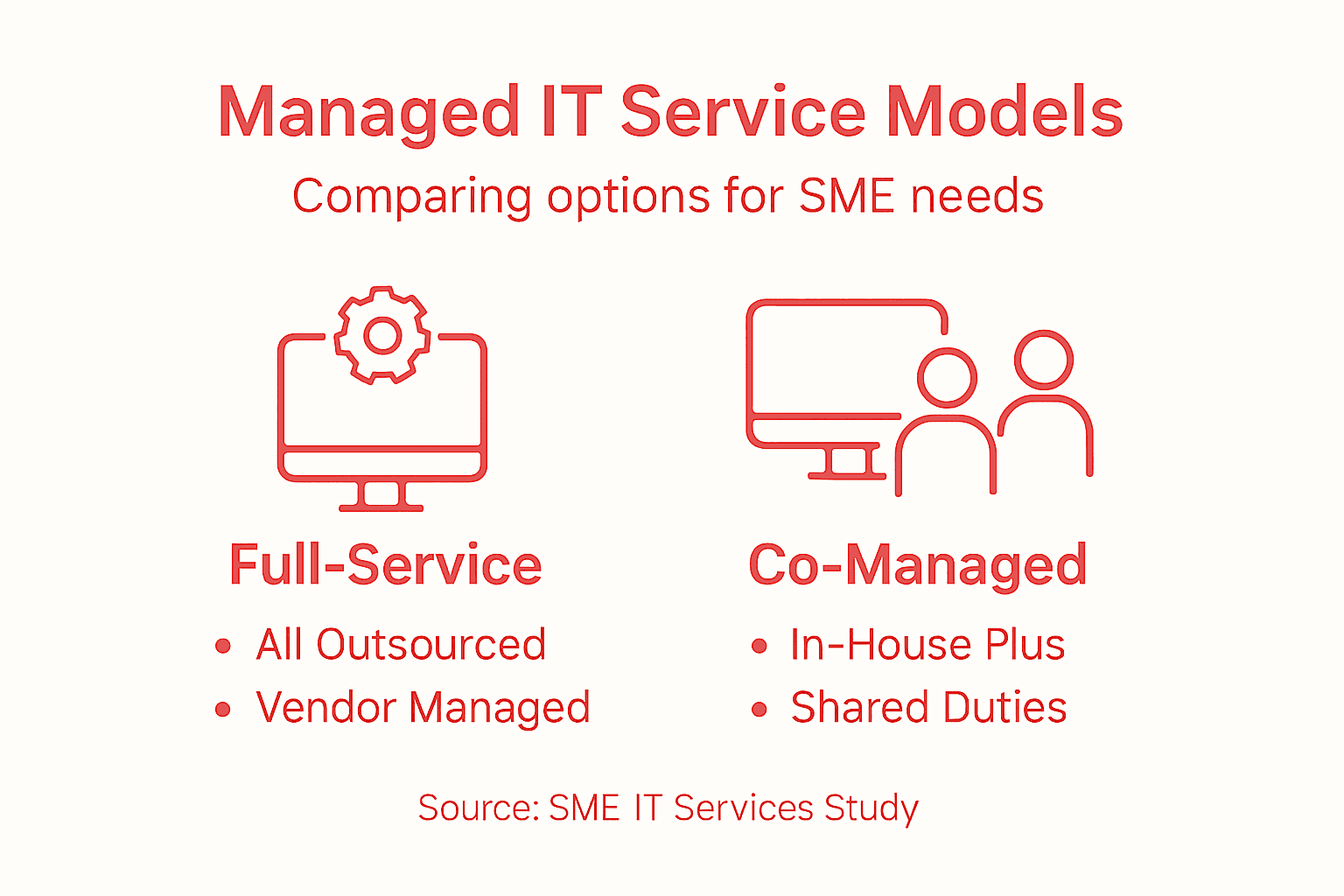
The first model, fully managed services, represents a comprehensive approach where the IT service provider assumes complete responsibility for an organisation’s entire technological infrastructure. This model is particularly beneficial for SMEs with limited internal IT expertise, offering end-to-end management of systems, networks, cybersecurity, and technical support. Under this model, the provider handles everything from routine maintenance to complex technological challenges, allowing business leaders to focus entirely on core operational objectives.
Alternative service models provide more nuanced approaches to technological management:
- Fully Managed Services: Complete technological infrastructure management
- Co-Managed Services: Shared responsibility between internal IT teams and external providers
- Standalone Services: Targeted support for specific technological functions
Co-managed services represent a hybrid approach, enabling businesses to maintain some internal control while leveraging external expertise. This model works exceptionally well for organisations with existing IT personnel who require supplementary support or specialised skills. Standalone services offer the most flexible option, allowing SMEs to procure targeted technological support for specific domains such as cybersecurity, cloud migration, or network infrastructure.
Pro tip: Conduct a comprehensive audit of your current IT capabilities and future technological requirements before selecting a managed IT service model to ensure optimal alignment with your business strategy.
The following table summarises how each managed IT service model fits different business needs:
| Service Model | Best For | Level of Control |
|---|---|---|
| Fully Managed | SMEs with no IT staff | External provider only |
| Co-Managed | SMEs with internal IT expertise | Shared responsibility |
| Standalone Services | SMEs with targeted requirements | Customisable support |
Legal and Regulatory Compliance for UK SMEs
Navigating the complex landscape of legal and regulatory requirements represents a critical challenge for small and medium enterprises (SMEs) in the United Kingdom. Information Commissioner’s Office guidelines provide comprehensive frameworks that outline the essential compliance obligations businesses must meet, particularly concerning data protection and information security.
The UK General Data Protection Regulation (UK GDPR) and the Data Protection Act 2018 establish stringent requirements for how organisations handle, process, and protect personal information. Managed IT services play a pivotal role in helping SMEs develop robust compliance strategies by implementing technical and organisational measures that ensure legal adherence. These measures include developing comprehensive data protection policies, conducting regular risk assessments, establishing secure data processing protocols, and creating mechanisms for prompt breach notification.
Key compliance areas that managed IT services support include:
- Data protection and privacy regulations
- Information security management
- Breach reporting and incident response
- Consent management and individual rights protection
- Documentation and audit trail maintenance
- Regular security and compliance assessments
Moreover, Financial Conduct Authority compliance support emphasises the importance of developing proactive governance frameworks that go beyond mere regulatory checkbox exercises. Managed IT providers help SMEs transform compliance from a potential administrative burden into a strategic advantage, enabling businesses to demonstrate their commitment to responsible data management and build trust with customers and stakeholders.
Pro tip: Establish a regular quarterly review process with your managed IT service provider to ensure continuous alignment with evolving legal and regulatory requirements.
Cost Structures and Financial Implications
Managed IT services have transformed the traditional financial approach to technological infrastructure for small and medium enterprises (SMEs), offering strategic cost management solutions that challenge conventional in-house IT spending models. These services provide predictable, scalable financial frameworks that enable businesses to convert unpredictable capital expenditures into manageable operational expenses.
The subscription-based model represents a fundamental shift in technological financial planning. Instead of substantial upfront investments in hardware, software, and specialised personnel, SMEs can now access comprehensive IT support through flexible monthly or annual contracts. This approach dramatically reduces financial risk, allowing businesses to access enterprise-grade technological capabilities without committing significant capital resources that might otherwise constrain business growth and innovation.
Key financial advantages of managed IT services include:
- Predictable monthly technology expenses
- Elimination of large capital expenditure investments
- Reduced recruitment and training costs for internal IT staff
- Immediate access to expert technological resources
- Scalable solutions that adapt to business growth
- Lower overall technology management expenses
Financial regulatory research underscores that managed IT services provide SMEs with economies of scale previously unavailable to smaller organisations. By pooling resources and expertise, these services enable businesses to benefit from advanced technological infrastructure and security measures at a fraction of the cost of developing such capabilities internally. This approach not only optimises financial resources but also allows business leaders to redirect strategic focus towards core operational objectives.
Pro tip: Request a comprehensive total cost of ownership analysis from potential managed IT service providers to understand the true financial implications beyond monthly subscription rates.
Here is a quick guide highlighting the financial impact of managed IT services compared to traditional in-house IT models:
| Cost Factor | Managed IT Services | In-House IT |
|---|---|---|
| Upfront Capital Expense | Minimal, mainly subscription | High, equipment/staff |
| Ongoing Costs | Predictable monthly fees | Variable, hard to plan |
| Internal Resource Needs | External experts utilised | Internal team required |
| Scalability | Easily adjusted by contract | Slow, resource-bound |
Key Benefits and Common Pitfalls to Avoid
Managed IT services offer transformative potential for small and medium enterprises, presenting a strategic approach to technological infrastructure that extends far beyond traditional support models. Enterprise research highlights the significant advantages these services provide, while simultaneously cautioning against potential implementation challenges.
The key benefits of managed IT services are substantial and multifaceted. Operational efficiency emerges as a primary advantage, enabling businesses to streamline technological processes, reduce downtime, and allocate internal resources more strategically. By leveraging external expertise, SMEs gain access to advanced technological capabilities that would be prohibitively expensive to develop internally. These services provide continuous monitoring, proactive maintenance, and rapid incident response, creating a robust technological ecosystem that supports business growth and innovation.
Common pitfalls that SMEs must carefully navigate include:
- Over-reliance on managed service providers
- Inadequate contract negotiation and management
- Insufficient alignment between service offerings and business objectives
- Lack of clear communication channels
- Neglecting ongoing staff training and technology understanding
- Failing to establish precise performance metrics
Management consultancy research emphasises the critical importance of thorough provider vetting and ongoing collaboration. Successful managed IT service relationships require a partnership approach, where the service provider is viewed as an extension of the internal team rather than a distant, transactional resource. Businesses must maintain active engagement, regularly review service performance, and ensure continuous alignment with evolving technological and strategic requirements.
Pro tip: Develop a comprehensive service level agreement that includes specific, measurable performance indicators and clear escalation protocols to maintain accountability and transparency.
Enhance Your SME’s Security and Efficiency with Expert Managed IT Services
Struggling with the complexities of IT security and the need for proactive technological support is common among SMEs aiming to scale securely and efficiently. This article highlights critical challenges such as maintaining robust cybersecurity, ensuring continuous system monitoring, and selecting the right managed IT service model tailored to your business needs. At Cloudology, we understand these pain points and specialise in delivering comprehensive IT solutions that transform your technology infrastructure into a strategic advantage.
Explore tailored offerings designed to improve your operational efficiency and fortify your digital defences at Uncategorized Archives – Cloudology. With services ranging from cloud hosting to data backup and proactive IT support, Cloudology helps you navigate the evolving landscape of IT management. Take control today by visiting Cloudology to discover how our expert team can safeguard your business and streamline IT operations. Don’t wait for disruptions to challenge your growth secure your SME’s future now.
Frequently Asked Questions
What are managed IT services?
Managed IT services involve outsourcing technology infrastructure and support functions to a third-party provider who is responsible for maintaining, monitoring, and managing a company’s IT systems, networks, and digital assets.
How can managed IT services improve security for SMEs?
Managed IT services provide advanced cybersecurity measures, proactive monitoring, and threat management that help SMEs protect against digital threats and vulnerabilities effectively, ensuring a robust security posture.
What are the key benefits of using managed IT services for efficiency?
Managed IT services enhance operational efficiency by streamlining technological processes, reducing downtime, and allowing SMEs to access expert resources that improve innovation and growth without the need for extensive internal IT infrastructure.
What are common myths about managed IT services that SMEs should be aware of?
A common myth is that managed IT services are only suitable for large corporations. In reality, tailored IT support solutions can be cost-effective for SMEs, helping them reduce overall technology costs and improve operational efficiency.