

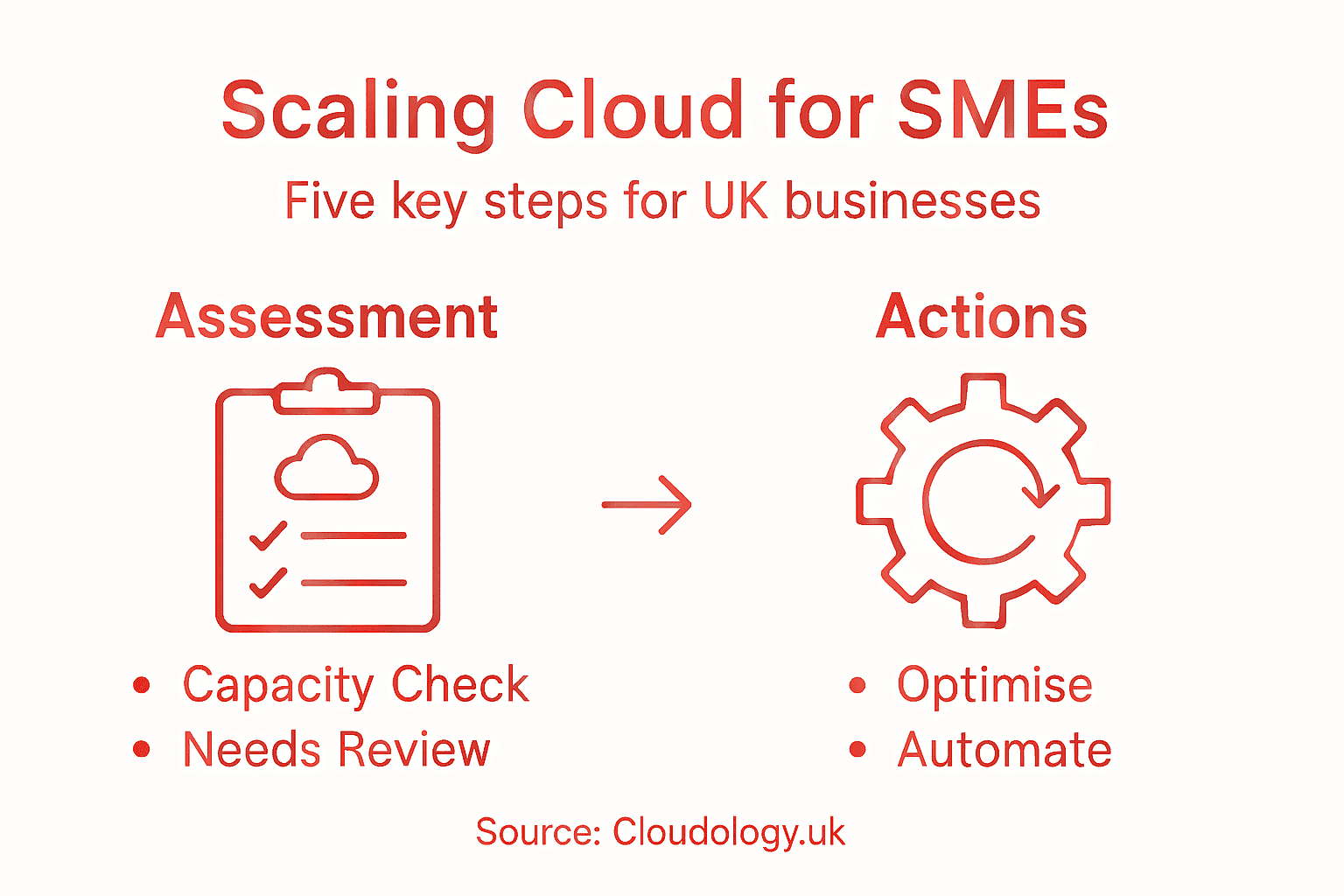
For many IT managers in British small to medium-sized enterprises, preparing cloud systems for future expansion feels more urgent than ever. With rapid shifts in technology and competitive business demands, a thoughtful strategy for scaling cloud infrastructure means more than just adding resources. By focusing on a comprehensive assessment of your environment and aligning it with business objectives, you lay the foundation for both increased efficiency and robust security throughout your digital transformation journey.
Table of Contents
- Step 1: Assess Current Cloud Capacity And Business Needs
- Step 2: Optimise Workloads For Flexible Scaling
- Step 3: Implement Automated Scaling Policies Securely
- Step 4: Monitor Performance And Security Continuously
- Step 5: Test And Validate Scalability Improvements
Quick Summary
| Key Insight | Explanation |
|---|---|
| 1. Assess current cloud capacity | Start by evaluating existing IT resources and future business requirements to guide effective scaling. |
| 2. Optimise workloads for flexibility | Leverage AI tools and implement containerisation for dynamic resource management according to demand. |
| 3. Implement secure automated scaling | Design scaling policies that enforce security while dynamically adjusting resources based on performance metrics. |
| 4. Continuously monitor performance and security | Use advanced dashboards and automated alerts to maintain operational integrity and preemptively address issues. |
| 5. Validate scalability improvements | Conduct rigorous testing to ensure scalability strategies deliver measurable enhancements without compromising security. |
Step 1: Assess current cloud capacity and business needs
Successfully scaling your cloud infrastructure begins with a comprehensive evaluation of your current technological landscape and future business requirements. This crucial first step involves a strategic audit of your existing IT resources, performance needs, and growth projections.
To conduct an effective assessment, start by mapping your technology infrastructure across three critical dimensions. First, analyse your current computational workloads by examining data storage requirements, processing power, and network bandwidth usage. Gather precise metrics on:
- Current server utilisation rates
- Peak performance periods
- Data transfer volumes
- Application response times
- Number of concurrent users
Second, review your business objectives and anticipated growth trajectory. This involves collaborating closely with department heads to understand future scalability requirements. Pay particular attention to potential expansion plans, new product launches, or market diversification strategies that might impact your technological needs.
A thorough cloud infrastructure assessment is not just about current capacity, but anticipating future technological demands.
Lastly, evaluate your existing technological ecosystem for potential integration challenges. Map out your current software applications, legacy systems, and interdependencies to ensure seamless cloud migration and scalability.

Pro tip: Engage a cross-functional team during your assessment to capture nuanced technological requirements from different business perspectives.
Step 2: Optimise workloads for flexible scaling
Scaling cloud infrastructure requires strategic workload optimisation that enables your business to adapt rapidly to changing technological demands. This step focuses on transforming your computational resources into a dynamic, responsive ecosystem that can efficiently manage fluctuating business requirements.
Begin by leveraging AI-powered cloud tools to automate and intelligently manage your computational resources. These advanced tools can help you dynamically adjust computing capacity based on real-time performance metrics and anticipated demand. Key strategies for workload optimisation include:
- Implement containerisation technologies
- Utilise serverless computing architectures
- Deploy intelligent auto-scaling mechanisms
- Develop granular resource allocation policies
- Establish automated performance monitoring systems
Prioritise workload distribution across multiple cloud environments to enhance resilience and prevent potential bottlenecks. This approach allows you to spread computational tasks across different servers and regions, ensuring consistent performance and minimising potential service interruptions.
Effective workload optimisation transforms your cloud infrastructure from a static resource into a responsive, intelligent system.
Consider implementing microservices architecture, which enables more granular and flexible scaling of individual application components. By breaking down complex applications into smaller, independently manageable services, you can achieve more precise resource allocation and faster response times.
Pro tip: Regularly conduct performance benchmarking and simulation tests to validate your workload optimisation strategies and identify potential improvement areas.
Step 3: Implement automated scaling policies securely
Designing secure automated scaling policies is a critical step in creating a robust and responsive cloud infrastructure for your UK SME. This process involves developing intelligent mechanisms that can dynamically adjust your computational resources while maintaining stringent security protocols.
Begin by implementing comprehensive cloud security controls that protect your infrastructure during automated scaling processes. Your automated policies should incorporate multiple layers of security to ensure continuous protection:
- Implement role-based access controls
- Establish multi-factor authentication
- Configure real-time security monitoring
- Define granular permission settings
- Create automated compliance verification mechanisms
Develop adaptive scaling rules that respond to specific performance metrics while simultaneously enforcing security constraints. This means creating policies that can expand or contract your computational resources based on predefined thresholds, but only within a tightly controlled security envelope.
Effective automated scaling is about balancing performance flexibility with unwavering security standards.
Ensure your scaling policies include continuous encryption, robust identity management, and automated threat detection. By integrating security directly into your scaling mechanisms, you create a dynamic yet protected cloud environment that can respond rapidly to changing business demands without compromising data integrity.
Pro tip: Conduct periodic penetration testing and security audits to validate the integrity of your automated scaling policies and identify potential vulnerabilities.
Step 4: Monitor performance and security continuously
Continuous monitoring is the cornerstone of maintaining a robust and secure cloud infrastructure for your UK SME. By implementing a proactive approach to performance tracking and security surveillance, you can detect and address potential issues before they escalate into significant problems.
Strategic digital performance monitoring enables your business to maintain operational transparency and technological resilience. Develop a comprehensive monitoring strategy that encompasses multiple critical dimensions:
- Real-time resource utilisation tracking
- Automated security vulnerability scanning
- Performance baseline establishment
- Anomaly detection mechanisms
- Comprehensive logging and audit trails
Implement advanced monitoring dashboards that provide holistic visibility into your cloud infrastructure’s health. These dashboards should integrate metrics from various systems, offering a unified view of performance, security, and potential risk areas.
Effective monitoring transforms raw data into actionable intelligence, enabling proactive technological management.
Establish automated alert systems that trigger immediate notifications for any suspicious activities, performance degradations, or potential security breaches. Configure these alerts with graduated response protocols, ensuring that different types of incidents receive appropriate and proportionate attention.
Pro tip: Schedule regular review sessions with your IT team to analyse monitoring data, identifying trends and potential optimisation opportunities.
Here is a comparison of core scaling strategies and their unique business impacts:
| Scaling Strategy | Key Benefit | Typical Use Case |
|---|---|---|
| Automated Scaling | Rapid resource adjustment | Responding to traffic surges |
| Microservices Adoption | Granular scalability | Managing modular applications |
| Multi-Cloud Distribution | Improved resilience | Minimising downtime & outages |
| Continuous Monitoring | Early threat detection | Proactive performance management |
Step 5: Test and validate scalability improvements
Validating your cloud infrastructure’s scalability is a critical phase that transforms theoretical improvements into practical, reliable performance enhancements. This step ensures that your carefully designed scaling strategies actually deliver the anticipated operational benefits for your UK SME.
Begin by implementing rigorous performance validation protocols that comprehensively assess your cloud infrastructure’s capabilities. Your testing strategy should encompass multiple dimensions of performance and resilience:
- Conduct load testing under varying computational demands
- Simulate peak traffic scenarios
- Measure response times across different scaling configurations
- Test failover and recovery mechanisms
- Validate data integrity during scaling events
Develop systematic benchmarking frameworks that provide quantitative insights into your infrastructure’s performance characteristics. These frameworks should include detailed metrics that demonstrate how your scaling improvements impact critical business operations.
Effective scalability testing transforms theoretical potential into measurable technological performance.
Ensure your validation processes include comprehensive security assessments alongside performance testing. This holistic approach guarantees that your scalability improvements do not compromise system integrity or introduce potential vulnerabilities.
Pro tip: Document every test iteration meticulously, creating a comprehensive performance baseline that enables continuous improvement and strategic technology decision-making.
The following table summarises essential validation tests and what they ensure for cloud infrastructure:
| Validation Test | Purpose | Business Assurance |
|---|---|---|
| Load Testing | Assess peak performance | Confirms scalability under stress |
| Failover Simulation | Test recovery capability | Demonstrates operational continuity |
| Security Assessment | Identify vulnerabilities | Protects data and compliance |
| Response Time Analysis | Measure delay and latency | Optimises user experience |
Unlock Scalable Cloud Solutions Tailored for UK SMEs
Scaling your cloud infrastructure can be complex without the right partner. This article highlights key challenges such as workload optimisation, automated scaling policies with strong security, and continuous performance monitoring — all critical for UK SMEs aiming to grow confidently. If you seek to overcome these hurdles and ensure your technology adapts seamlessly to your business demands, professional support is essential.
At Cloudology.uk, we specialise in delivering reliable, secure, and scalable IT infrastructure designed specifically for SMEs. Explore our insights in the Uncategorized Archives – Cloudology to deepen your understanding, then take the next step by visiting Cloudology.uk to discover how our expert IT support, cloud hosting, and tailored solutions can simplify your technology management while boosting your business resilience and productivity.
Dont wait until scaling challenges slow your growth. Partner with us today for a cloud infrastructure that scales with your ambition and secures your data every step of the way.
Frequently Asked Questions
What is the first step to assess cloud capacity for SMEs?
To assess cloud capacity successfully, start by evaluating your current technological landscape and future business needs. Conduct a thorough audit by mapping your technology infrastructure, including server utilisation rates and data transfer volumes, to identify performance metrics and scalability requirements.
How can I optimise workloads for flexible scaling in my cloud infrastructure?
Optimising workloads involves leveraging containerisation technologies and implementing auto-scaling mechanisms. Begin by distributing workloads across multiple cloud environments to enhance resilience and ensure efficient resource allocation while adapting to fluctuating business demands.
What security measures should be implemented during automated scaling?
It is essential to implement comprehensive cloud security controls such as role-based access and multi-factor authentication during automated scaling. Establish adaptive scaling rules that adjust resources based on performance metrics while adhering to strict security protocols to safeguard your infrastructure.
How do I continuously monitor the performance and security of my cloud infrastructure?
To continuously monitor performance and security, develop a comprehensive strategy that includes real-time resource tracking and automated security vulnerability scanning. Implement advanced monitoring dashboards that integrate multiple metrics, allowing you to detect anomalies and receive immediate alerts for any suspicious activities.
What types of tests are essential for validating scalability improvements?
Essential tests for validating scalability include load testing, failover simulations, and security assessments. Conduct these tests to measure response times and ensure operational continuity while documenting results to establish a comprehensive performance baseline for continuous improvement.