

More than 80 percent of British SMEs now list IT infrastructure costs and reliable scalability as top priorities. The choice between cloud and hosted servers is shaping how British businesses handle security, adapt to demand, and control spending. Understanding the real differences matters when every decision directly affects operational resilience and compliance. This comparison reveals what modern British IT managers need to consider to build flexible, secure, and cost-effective server strategies.
Table of Contents
- Core Differences Between Cloud And Hosted Servers
- How Cloud Servers Operate For Businesses
- Traditional Hosted Servers: Structure And Uses
- Scalability, Control, And Maintenance Compared
- Cost, Security, And Compliance Impacts
Key Takeaways
| Point | Details |
|---|---|
| Scalability | Cloud servers offer instant resource scaling, while hosted servers require manual hardware upgrades. |
| Cost Structure | Cloud solutions generally utilise a pay-as-you-go pricing model, contrasting with the significant upfront investment needed for hosted servers. |
| Management | Cloud providers manage infrastructure maintenance, reducing the burden on in-house IT teams compared to hosted servers. |
| Security and Compliance | Cloud environments necessitate strict data protection strategies due to multi-tenancy, whereas hosted servers allow for granular security control but demand extensive internal expertise. |
Core Differences Between Cloud And Hosted Servers
Understanding the core differences between cloud and hosted servers is crucial for UK SMEs seeking efficient, scalable IT infrastructure. While both technologies provide computing resources, they operate through fundamentally different architectural approaches. Cloud infrastructure services represent a more dynamic, flexible solution compared to traditional hosted server models.
Traditional hosted servers involve dedicated physical or virtual machines leased or owned by a business, where the organisation maintains direct control over hardware and software infrastructure. In contrast, cloud servers provide on-demand computing resources through remote, shared infrastructure managed by third-party providers. The key distinction lies in resource allocation and management: cloud environments enable automatic scaling and resource sharing, whereas hosted servers require manual intervention and fixed hardware investments.
The primary differentiators between cloud and hosted servers include:
- Scalability: Cloud servers can rapidly scale resources up or down based on demand
- Cost Structure: Cloud uses pay-as-you-go models, while hosted servers demand upfront hardware investments
- Management Complexity: Cloud providers handle infrastructure maintenance, reducing internal IT workload
- Performance: Cloud offers distributed computing power, hosted servers rely on specific hardware capabilities
- Redundancy: Cloud platforms provide built-in failover and backup mechanisms
Pro tip: Before migrating, conduct a comprehensive audit of your current IT infrastructure to determine which server model best matches your specific business requirements and growth trajectory.
Here’s an at-a-glance comparison of business impacts when choosing cloud versus hosted servers:
| Business Factor | Cloud Servers | Hosted Servers |
|---|---|---|
| Initial Investment | Minimal upfront costs | Substantial capital outlay |
| Adaptability | Rapid adjustment to change | Slow, hardware-dependent pace |
| IT Staffing Needs | Reduced internal requirement | Requires skilled in-house team |
| Compliance Complexity | Multi-region implications | Controlled, direct oversight |
How Cloud Servers Operate For Businesses
Cloud servers represent a transformative technology enabling UK businesses to access sophisticated computing resources without substantial infrastructure investments. Cloud infrastructure services provide organisations with flexible, remote computing capabilities through virtualised environments hosted across global data centres.
At their core, cloud servers operate through a distributed computing model where businesses can provision and manage computing resources dynamically. Unlike traditional server setups, cloud infrastructure allows companies to access compute power, storage, and networking capabilities on-demand. This approach enables rapid scaling, with organisations able to increase or decrease resources instantaneously based on operational requirements. UK data protection guidelines emphasise that cloud platforms must maintain rigorous security standards while delivering operational efficiency.
The key operational mechanisms of cloud servers include:
- Virtualisation: Creating multiple virtual machines on shared physical hardware
- Resource Pooling: Aggregating computing resources to serve multiple clients
- Elastic Scaling: Automatically adjusting computational capacity
- Multi-Tenancy: Securely hosting different organisations’ data on shared infrastructure
- Automated Management: Handling updates, security patches, and infrastructure maintenance
Cloud server architectures typically operate through three primary service models:
- Infrastructure as a Service (IaaS): Providing raw computing infrastructure
- Platform as a Service (PaaS): Offering development and deployment environments
- Software as a Service (SaaS): Delivering complete application ecosystems
Pro tip: Conduct a comprehensive workload assessment to determine which cloud service model best aligns with your specific business technology requirements and growth strategy.
Traditional Hosted Servers: Structure And Uses
Traditional hosted servers represent a longstanding infrastructure model where businesses maintain direct control over their computing resources. Data protection regulations underscore the importance of understanding these server architectures, particularly for organisations requiring precise infrastructure management.

At their core, traditional hosted servers involve dedicated physical or virtual machines that are either owned outright or leased by an organisation. These servers can be situated on-premises or within a managed data centre, providing businesses with complete control over hardware, software configurations, and network environments. Unlike cloud solutions, traditional hosted servers offer a more static and predictable computing infrastructure, making them ideal for workloads with consistent resource requirements and stringent compliance needs.
Key characteristics of traditional hosted servers include:
- Dedicated Hardware: Exclusive use of physical or virtual server resources
- Full Administrative Control: Complete management of infrastructure
- Predictable Performance: Consistent computational capabilities
- Enhanced Security Configuration: Customisable security parameters
- Legacy Application Support: Compatibility with older software systems
Traditional hosted servers are particularly suitable for specific business scenarios:
- Regulated industries requiring strict data sovereignty
- Applications with complex, specialised configuration needs
- Organisations with substantial existing IT infrastructure investments
- Workloads demanding consistent, uninterrupted computational resources
- Businesses with specific compliance or auditing requirements
Pro tip: Conduct a comprehensive infrastructure audit to determine whether your specific operational requirements align more closely with traditional hosted servers or cloud-based solutions.
For quick reference, here are typical use cases for each server model:
| Use Case | Cloud Servers | Hosted Servers |
|---|---|---|
| Temporary project deployments | Ideal for fast scaling | Impractical, needs hardware changes |
| Legacy system support | Limited compatibility | Excellent for older applications |
| Handling confidential data | Depends on provider’s protocols | Direct data control |
| High-performance workloads | Distributed power, flexible | Stable, predictable performance |
Scalability, Control, And Maintenance Compared
Comparing cloud and hosted servers reveals significant differences in how businesses manage their technological infrastructure. Cloud service architectures demonstrate remarkable flexibility in resource allocation that traditional hosted servers cannot easily match.
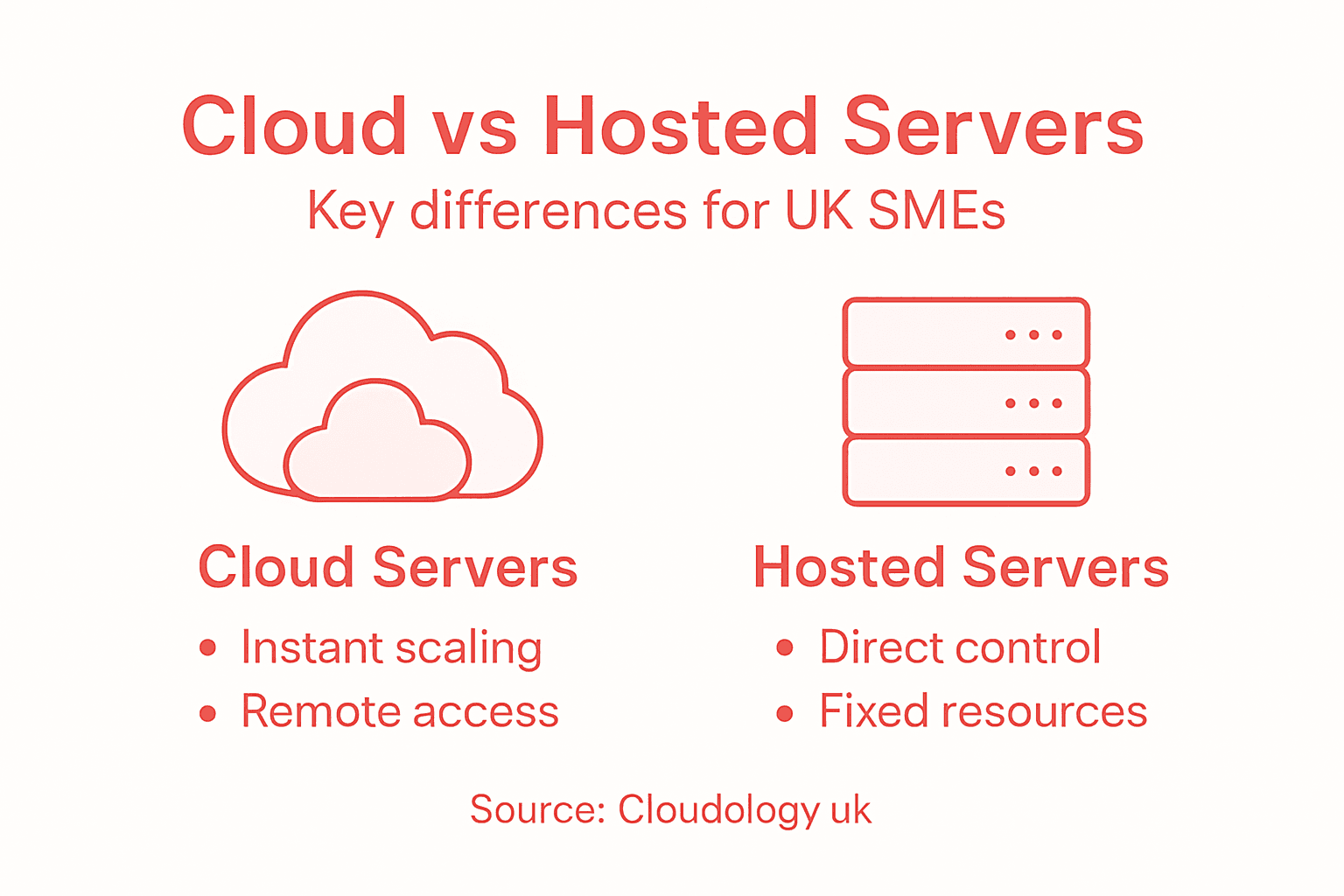
Scalability represents the most pronounced distinction between these two server models. Cloud environments enable businesses to dynamically adjust computing resources within minutes, scaling up or down based on immediate operational demands. Traditional hosted servers, by contrast, require manual hardware upgrades and have inherently limited expansion capabilities. This fundamental difference means cloud solutions offer unprecedented agility, while hosted servers provide more predictable, though less flexible, computational environments.
Key comparative aspects include:
-
Scalability:
- Cloud: Instant resource adjustment
- Hosted: Requires physical hardware upgrades
-
Control:
- Cloud: Provider-managed with configurable settings
- Hosted: Direct, comprehensive administrative control
-
Maintenance:
- Cloud: Managed by service provider
- Hosted: Internal IT team or contracted support required
Cross-cloud infrastructure research highlights that while cloud solutions reduce maintenance overhead, hosted servers offer more granular security and customisation options. Organisations must carefully evaluate their specific technological requirements when selecting between these infrastructure models.
The optimal choice depends on several critical factors:
- Regulatory compliance requirements
- Budget constraints
- Performance expectations
- Security sensitivity
- Technical expertise available
Pro tip: Conduct a comprehensive workload analysis to determine which server model provides the most appropriate balance between scalability, control, and operational efficiency for your specific business needs.
Cost, Security, And Compliance Impacts
Navigating the complex landscape of server infrastructure requires a nuanced understanding of cost, security, and regulatory considerations. Cloud computing agreements demand meticulous examination to protect business interests and ensure comprehensive legal compliance.
Financial implications represent a critical decision point for UK SMEs. Cloud services typically offer a pay-as-you-go model that transforms capital expenditure into operational expenses, allowing businesses to scale resources without substantial upfront investments. Hosted servers, by contrast, require significant initial hardware purchases and ongoing maintenance costs. Ofcom’s market analysis highlights that while cloud solutions can reduce immediate financial barriers, long-term costs can fluctuate based on usage patterns and provider pricing structures.
Key comparative aspects of cost, security, and compliance include:
-
Cost Considerations:
- Cloud: Flexible, usage-based pricing
- Hosted: Fixed infrastructure investments
-
Security Responsibilities:
- Cloud: Shared responsibility model
- Hosted: Direct, comprehensive control
-
Compliance Challenges:
- Cloud: Complex multi-jurisdictional requirements
- Hosted: More straightforward regulatory management
The security landscape further complicates this decision. Cloud environments introduce multi-tenancy risks, requiring robust access controls and data protection strategies. Hosted servers offer more granular security configurations but demand significant internal technical expertise to maintain robust defences.
Critical evaluation factors for businesses include:
- Specific industry regulatory requirements
- Data sensitivity and protection needs
- Budget constraints
- Internal technical capabilities
- Scalability requirements
Pro tip: Engage a specialised IT compliance consultant to conduct a comprehensive risk assessment before selecting your server infrastructure model.
Unlock the Best IT Infrastructure for Your Business Today
Choosing between cloud and hosted servers can feel overwhelming especially when factors like scalability, cost, security, and compliance are on the line. Many UK SMEs face challenges determining which solution truly fits their unique operational needs while maintaining control and minimising risks. The key is understanding how dynamic cloud services contrast with traditional hosted setups to make informed decisions that accelerate growth and safeguard your data.
At Cloudology.uk, we specialise in guiding businesses through this complex landscape by delivering tailored IT solutions focused on modern cloud hosting, seamless IT support, and robust data security. If you want to transform your infrastructure with flexible, scalable options while simplifying IT management explore our Uncategorized Archives – Cloudology for insightful resources and expert advice. Don’t let uncertainty hold back your company’s potential. Contact us now to get a personalised consultation and experience the confidence that comes from partnering with a trusted IT service provider dedicated to your business success.
Frequently Asked Questions
What is the main difference between cloud servers and hosted servers?
Cloud servers provide on-demand computing resources through shared infrastructure managed by third-party providers, enabling automatic scaling and flexibility. In contrast, hosted servers involve dedicated physical or virtual machines with direct control over hardware and software, requiring manual intervention for resource adjustments.
How do cloud servers enhance scalability for businesses?
Cloud servers can rapidly scale resources up or down based on demand, allowing businesses to adjust computing capabilities instantaneously without the need for physical hardware changes, unlike traditional hosted servers that require manual upgrades.
What are the cost implications of choosing cloud servers over hosted servers?
Cloud servers typically operate on a pay-as-you-go model, transforming capital expenditure into operational expenses, while hosted servers require substantial upfront investments in hardware and ongoing maintenance costs, making budgeting and financial predictions more straightforward for cloud solutions.
What security considerations should SMEs take into account when choosing between cloud and hosted servers?
Cloud environments have a shared responsibility model for security, which requires robust access controls and data protection strategies. On the other hand, hosted servers offer more granular security configurations but necessitate a higher level of internal technical expertise to maintain security protocols.